
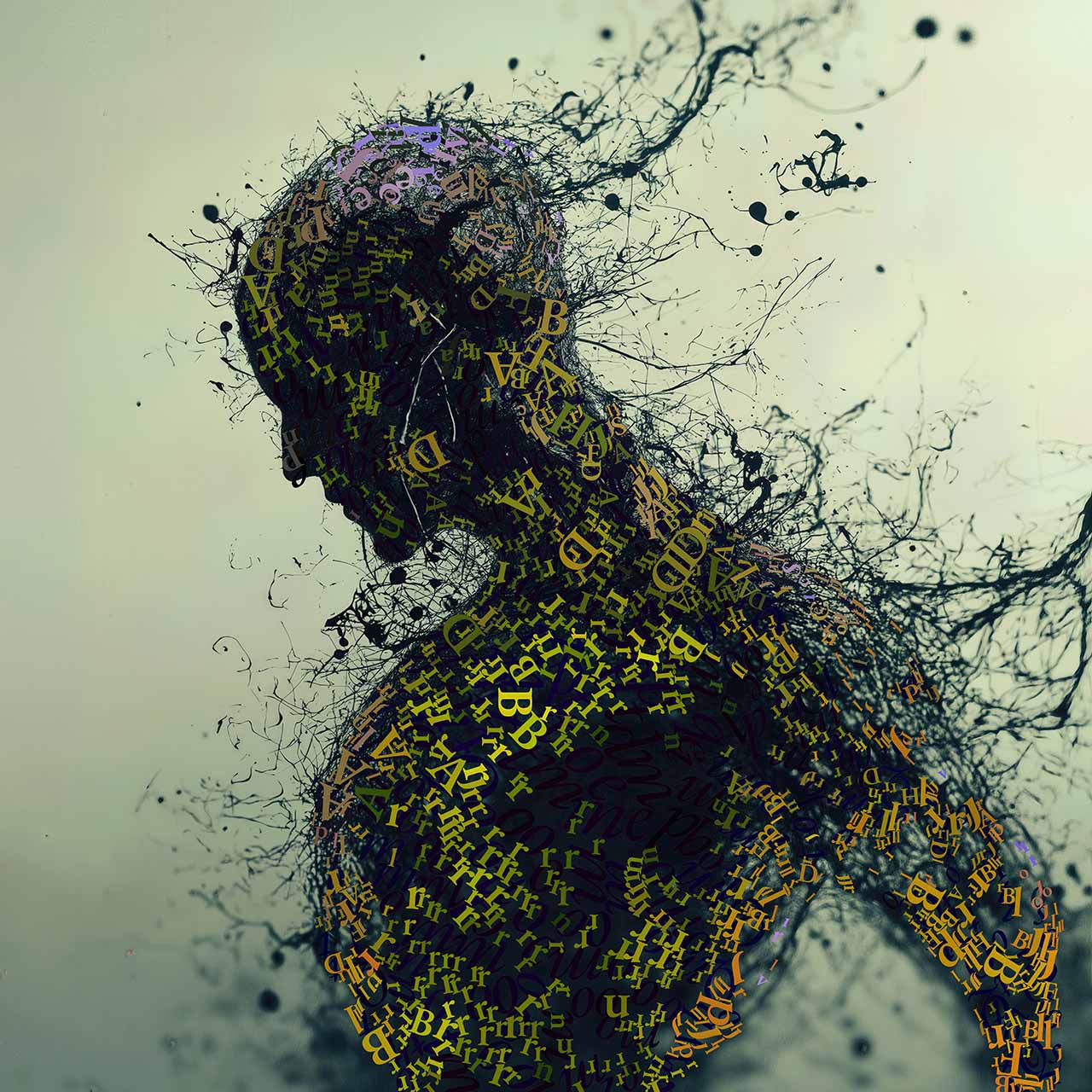
Corpus Typographicus tells the story of transformation — of the body turning into a trace, of being becoming imprint. Facing this fragmented figure, interwoven with a dense constellation of letters and symbols, we do not witness a simple dissolution, but something more profound and poetic: the body lightens, dematerializes, almost becomes soul. And yet, something remains.
What endures is a presence made of words, signs, fragments of language: a personal, singular lexicon etched through time. The letters that compose and envelop the figure are not random. They are echoes of thoughts, emotions, relationships — the intimate vocabulary of a lived existence. It is as if the artist has captured not the image of the body, but its semantic echo: what survives after the material form has faded.
In this delicate transition, the body becomes living memory, an intangible testimony. There is no tragedy in its disintegration — rather, a gentle transcendence: the body does not disappear, it is translated. And what remains is not emptiness, but imprint — a web of words that tells of what we have been, what we have spoken, what we have meant.
The work invites us to reflect on the ephemeral nature of flesh and the persistence of language. Because, perhaps, in the end, this is what we are: an alphabet that has passed through us, a story that has lived within us.
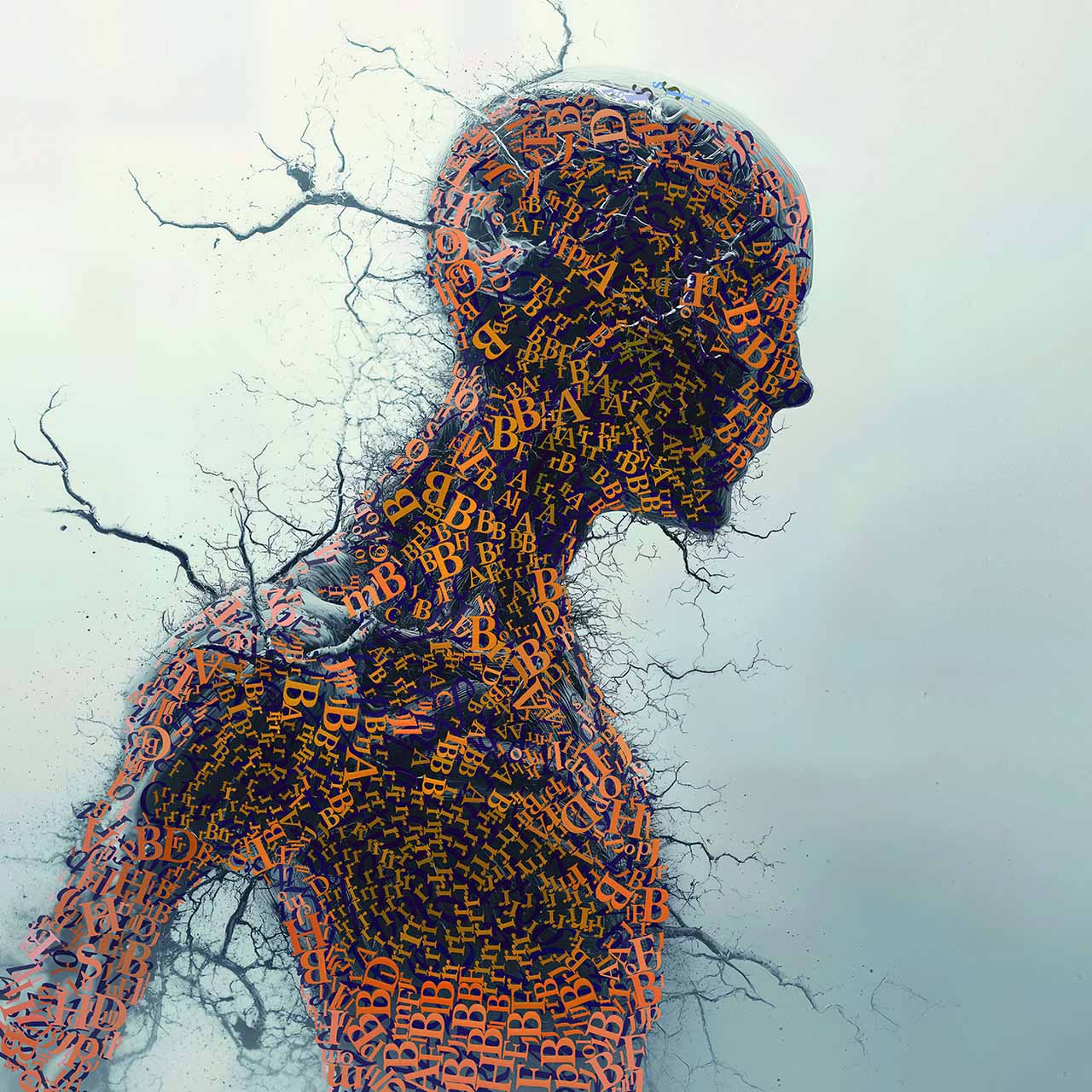
In Lexicon, the human figure stands distinct and silent, immersed in a cold and rarefied light. The body, once again devoid of flesh, is constructed from a dense network of letters — primarily in shades of orange and fiery red — that seem to pulse like linguistic cells. Each typographic sign appears not only as a visual ornament, but as an emotional trace, a mnemonic echo of lived experience. The individual is portrayed in an almost meditative state: composed, contained, listening to their own inner silence.
Compared to other works in the series, in Lexicon the disintegration is more subtle, more restrained. The dark branches extending from the figure outward suggest a nervous tension, a web of thoughts and memories that slowly expands into the surrounding space like impulses of consciousness. This is a body that does not implode but radiates: its soul, made of words, spreads silently into the void.
The work reflects on identity as a semiotic structure — a fragile balance between what composes us and what we let go of.
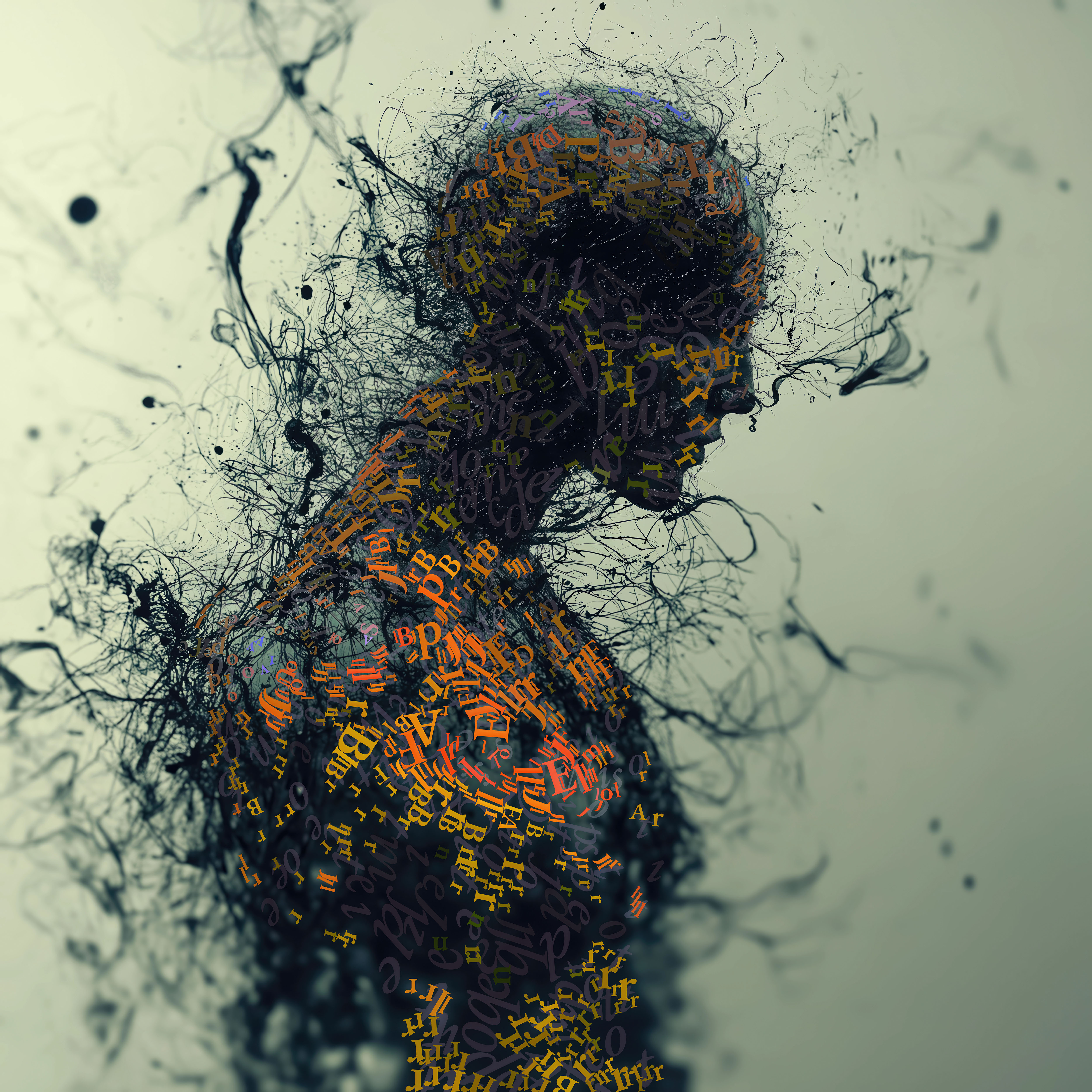
“Evanescence” presents itself as a poetic balance between body and spirit. At the center of the panel, thin black filaments suggest a body emerging like a light shadow, without defined contours—an embodiment of the fleeting nature of material existence. This irregular web of lines evokes contemporary trends that deconstruct traditional form, allowing a site of impermanent presence to surface.
Layered over this dark skeleton is an almost translucent veil acting as an “artificial skin”: a delicate membrane of light that separates the corporeal dimension from the more intimate one. Like a gentle screen, it lets the figure be seen without fully revealing it, recalling the idea of a soul moving behind a protected, suspended space.
Beneath this layer, letters in shades of brown and violet intertwine with the filaments, mapping out the landscape of the subconscious. These dense characters are traces of thoughts and sedimented memories—a psychic substrate that gives depth to the composition. Finally, inserts of yellow, orange, and especially bright red letters cluster around the heart, infusing the work with passion and vital warmth: an emotional glow that animates the entire figure and reveals how, beneath every evanescent appearance, there pulses an inner core of profound energies.
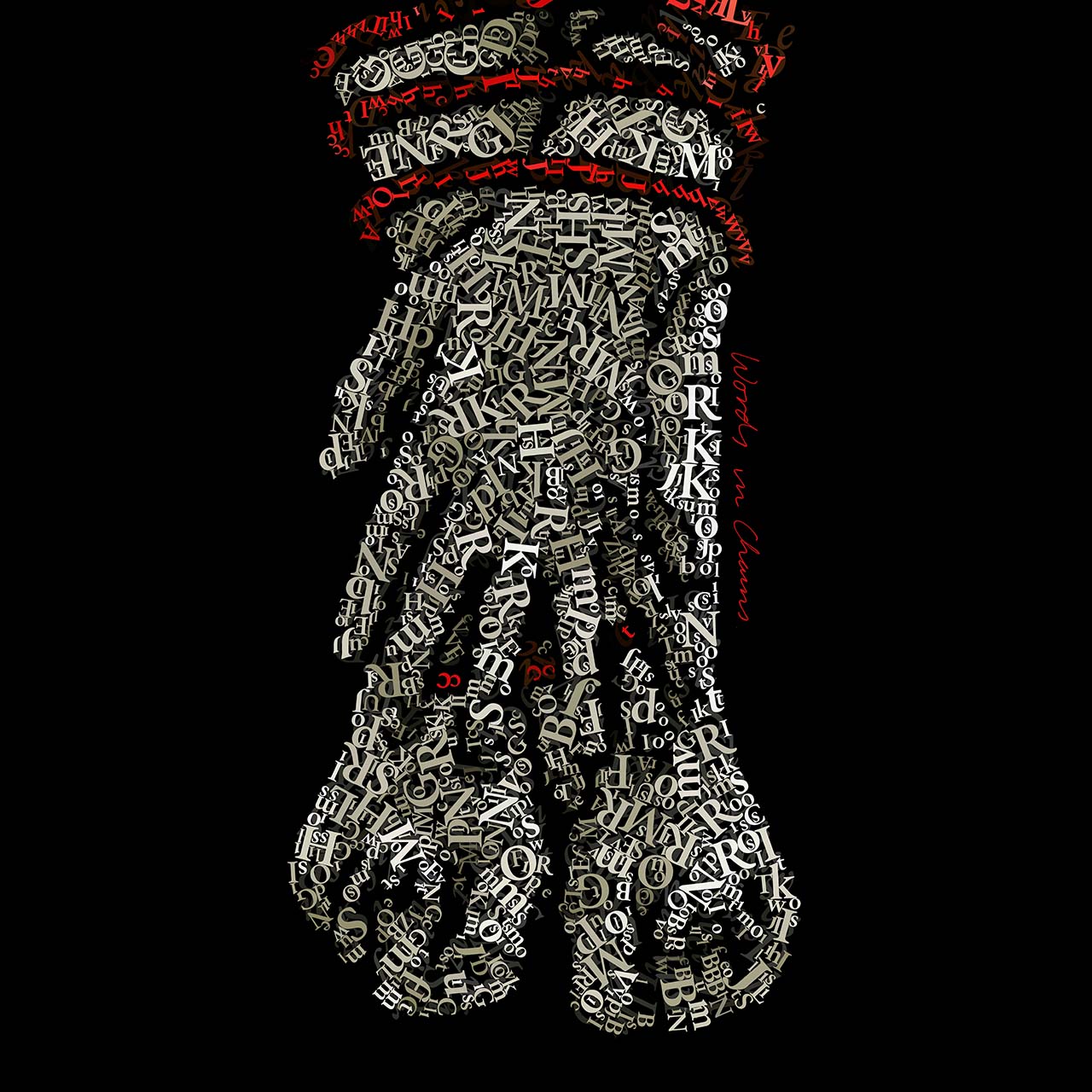
In Words in Chain, Christian Z translates language into a powerful and unsettling visual form, shaping a pair of bound hands composed entirely of overlapping, chaotic, screaming typographic characters. The work is a tangible manifestation of chained language—a silent cry where words, instead of liberating, become a prison. The anatomical form emerges from a dense forest of letters, as if identity itself were the result of a semantic overdose.
The black background dominates the composition, eliminating all context and amplifying the sense of isolation. The red chain around the wrists is not made of metal, but of words—alphabetic signs that, rather than communicating, suppress. The use of red is deliberate: a thread of emotional tension, a reference to blood, pain, but also passion and the possibility of rupture.
This piece stands strongly within the WORDS series, in which the artist explores the materiality of language as a structure of perception and consciousness. But here, language fails—folds in on itself and becomes a cage.
Christian Z invites us to reflect on the ambivalent power of words: they can build bridges, but also invisible chains. The image of the bound hands is symbolic and universal—evoking censorship, violence, social impotence—but also profoundly intimate, as if it were the inner voice itself being bound.
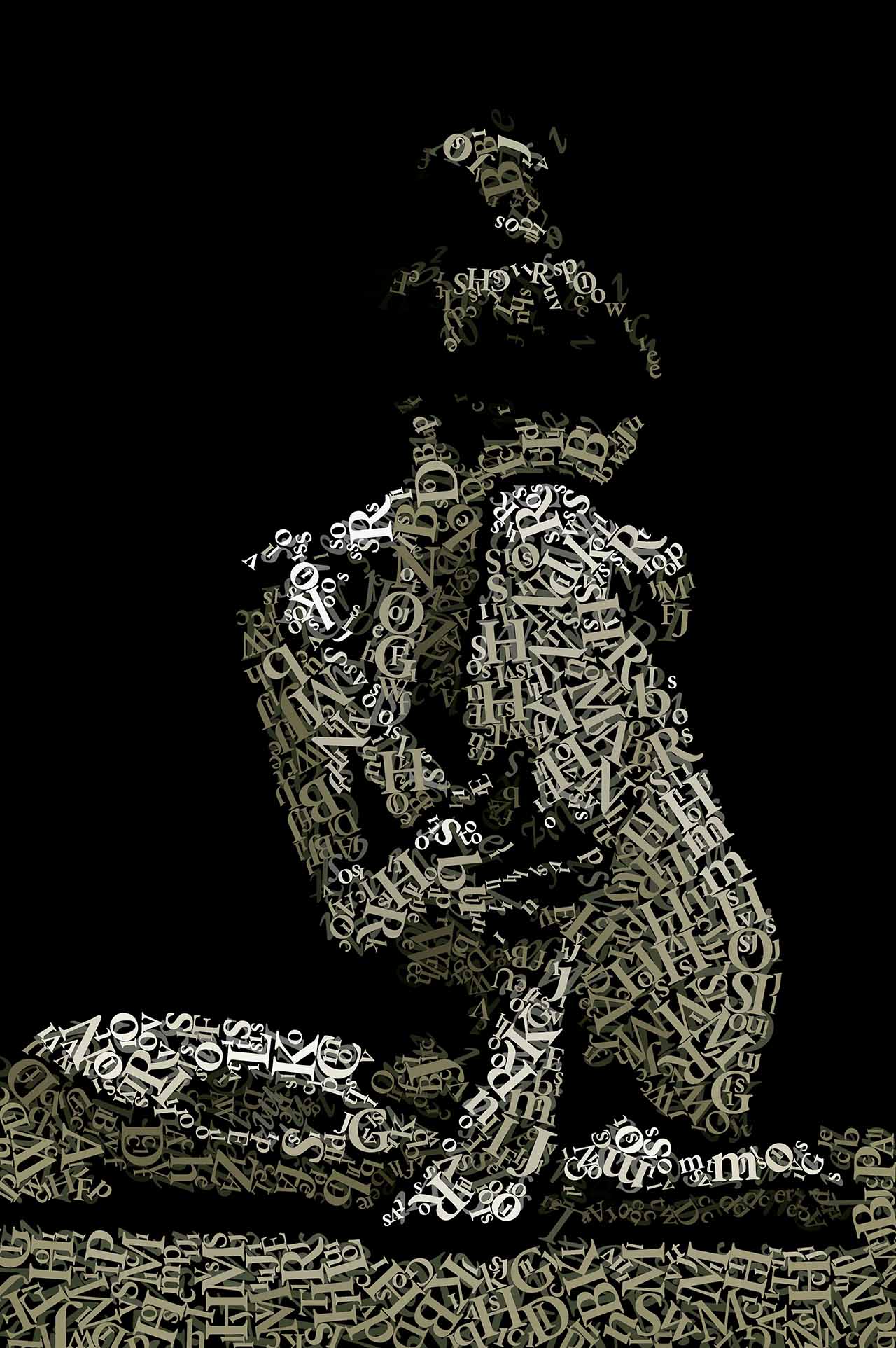
The collection “WORDS” – Invisible Codes, is presented as a transmutation of the intangible: giving shape to emotions, communication and the very essence of being human. Each work is a visual poem in which letters, normally bearers of meaning, become tangible matter, the fabric of humanity. It is the artist’s intention that the viewer will find in them a reflection of himself, his own words imprinted between the lines, his own story concealed between the letters that construct a universal identity.
Each work is designed to generate a three-dimensional vortex that leads the eye to the core of the human figure, a movement that seems to spring from apparent chaos. From a close view, the letters appear to merge and blur, but as they recede, a luminous harmony emerges: a balance born of disorder, ultimately revealing itself as a celebration of the beauty inherent in the complexity of human beings.
Each painting is enclosed in a 4.5 cm thick aluminum frame, which adds a modern and refined touch, emphasizing the contrast between the vibrancy of the colors and the linear structure of the frame.
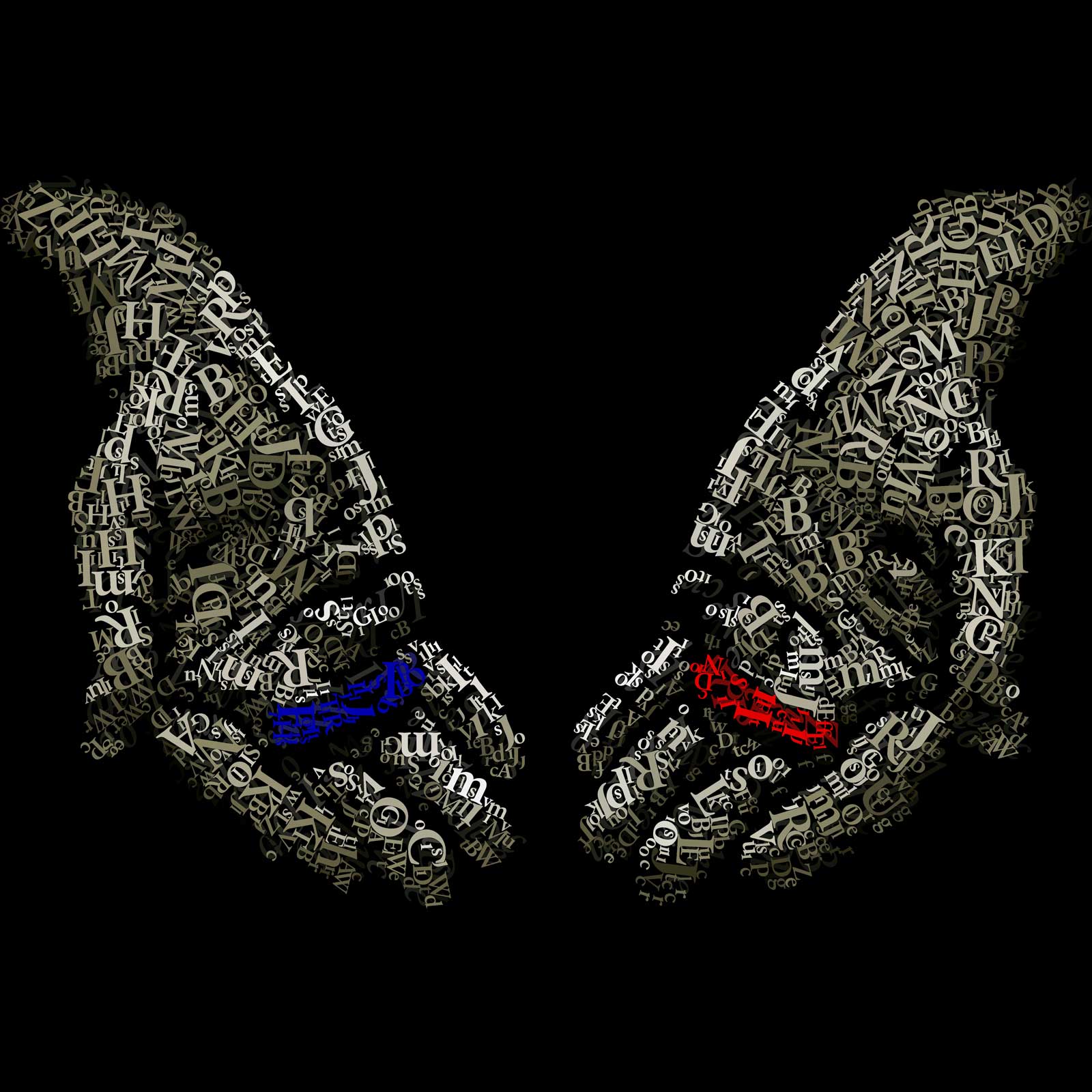
The collection “WORDS” – Invisible Codes, is presented as a transmutation of the intangible: giving shape to emotions, communication and the very essence of being human. Each work is a visual poem in which letters, normally bearers of meaning, become tangible matter, the fabric of humanity. It is the artist’s intention that the viewer will find in them a reflection of himself, his own words imprinted between the lines, his own story concealed between the letters that construct a universal identity.
Each work is designed to generate a three-dimensional vortex that leads the eye to the core of the human figure, a movement that seems to spring from apparent chaos. From a close view, the letters appear to merge and blur, but as they recede, a luminous harmony emerges: a balance born of disorder, ultimately revealing itself as a celebration of the beauty inherent in the complexity of human beings.
