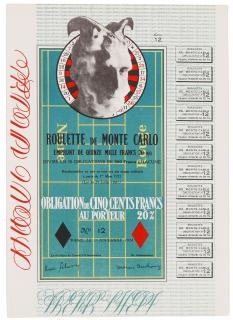
![Marcel Duchamp - De Ou Par Marcel Duchamp Ou Rrose Sélavy. [Boite-En-Valise]. Paris And Milan, 1966](/images/marcel-duchamp_de-ou-par-marcel-duchamp-ou-rrose-selavy-boite-en-valise-paris-and-milan-1966_AID333195.jpg?f=grey)
Marcel Duchamp
De Ou Par Marcel Duchamp Ou Rrose Sélavy. [Boite-En-Valise]. Paris And Milan, 1966
Found at
Sothebys,
New York
Dada Data: Books and Boîtes by Marcel Duchamp and Others, Lot 23
16. Nov - 16. Nov 2020
Dada Data: Books and Boîtes by Marcel Duchamp and Others, Lot 23
16. Nov - 16. Nov 2020
Estimate: XX.XXX
Price realised: XX.XXX
Price realised: XX.XXX
Description
Property from the Collection of Carlos Alberto Cruz
MARCEL DUCHAMP
DE OU PAR MARCEL DUCHAMP OU RROSE SÉLAVY. [BOITE-EN-VALISE]. PARIS AND MILAN, 1966
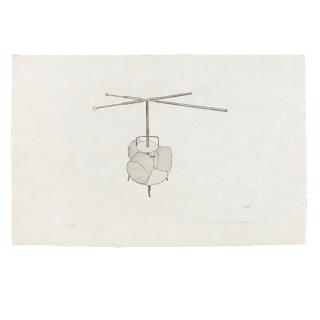
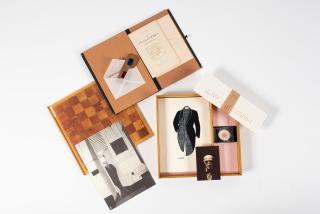
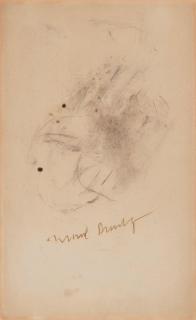
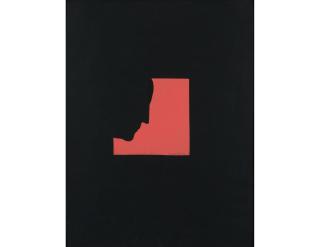
Miniature replicas and color and black-and-white reproductions of works by Duchamp contained in a red leather clamshell case (16 1/4 x 15 x 3 3/4 x 3 3/4 in.; 413 x 381 x 95 mm) lined in red buckram; many reproductions and printed labels have become detached from their black paper mounts (as per usual) due to evaporation of glue, wooden mounts also detached for same reason, but all present, leather case with some wear at extremities.
Marcel Duchamp. De ou par Marcel Duchamp ou Rrose Sélavy. [Boite-en-Valise]. Paris and Milan, 1966
"Everything important that I have done can be put into a little suitcase."One of 75 copies, signed by Duchamp on the buckram lining, of Series F (1966) of the celebrated Boite-en Valise.
Duchamp first began working on his Box in a Valise in Paris in 1940. When the Germans occupied Paris, he smuggled the parts out of France and assembled the boxes in New York. Robert Lebel remarked, "Characteristically, one year before the war Duchamp foresaw that he must pack his bags in as small a space as possible." In the years 1941 to 1966, he was to issue seven versions of valise (Series A–G). Series F was made in Milan under the supervisi
In a 1955 interview with James Johnson Sweeney, Duchamp elaborated on the idea behind the Box, "It was a new form of expression for me. Instead of painting something the idea was to reproduce the paintings that I loved so much in miniature. I didn't know how to do it. I thought of a book, but I didn't like that idea. The I thought of the idea of the box in which all my works would be mounted in a small museum, a portable museum, so to speak, and
Series F consists of the 68 reproductions and replicas found in the original Series A (1941–49) plus 12 additional reproductions. The present copy is accompanied by a note from dealer Claude Givaudan of Geneva to Mr. Cruz, 2 May 1978, certifying that the box was acquired from Marcel Duchamp in 1967 and is complete.
MARCEL DUCHAMP
DE OU PAR MARCEL DUCHAMP OU RROSE SÉLAVY. [BOITE-EN-VALISE]. PARIS AND MILAN, 1966
Miniature replicas and color and black-and-white reproductions of works by Duchamp contained in a red leather clamshell case (16 1/4 x 15 x 3 3/4 x 3 3/4 in.; 413 x 381 x 95 mm) lined in red buckram; many reproductions and printed labels have become detached from their black paper mounts (as per usual) due to evaporation of glue, wooden mounts also detached for same reason, but all present, leather case with some wear at extremities.
Marcel Duchamp. De ou par Marcel Duchamp ou Rrose Sélavy. [Boite-en-Valise]. Paris and Milan, 1966
"Everything important that I have done can be put into a little suitcase."One of 75 copies, signed by Duchamp on the buckram lining, of Series F (1966) of the celebrated Boite-en Valise.
Duchamp first began working on his Box in a Valise in Paris in 1940. When the Germans occupied Paris, he smuggled the parts out of France and assembled the boxes in New York. Robert Lebel remarked, "Characteristically, one year before the war Duchamp foresaw that he must pack his bags in as small a space as possible." In the years 1941 to 1966, he was to issue seven versions of valise (Series A–G). Series F was made in Milan under the supervisi
In a 1955 interview with James Johnson Sweeney, Duchamp elaborated on the idea behind the Box, "It was a new form of expression for me. Instead of painting something the idea was to reproduce the paintings that I loved so much in miniature. I didn't know how to do it. I thought of a book, but I didn't like that idea. The I thought of the idea of the box in which all my works would be mounted in a small museum, a portable museum, so to speak, and
Series F consists of the 68 reproductions and replicas found in the original Series A (1941–49) plus 12 additional reproductions. The present copy is accompanied by a note from dealer Claude Givaudan of Geneva to Mr. Cruz, 2 May 1978, certifying that the box was acquired from Marcel Duchamp in 1967 and is complete.


Auction result well in line with expectations
In November 2020 Sothebys in New York held the auction Dada Data: Books and Boîtes by Marcel Duchamp and Others, which included the work De Ou Par Marcel Duchamp Ou Rrose Sélavy. Boite-En-Valise. Paris And Milan, 1966 by Marcel Duchamp. It changed hands for a price of USD 226,800.00 (€ 189,822.56) achieving a result in the upper range of the estimate price range of USD 150,000.00 – 250,000.00. Of course, this price has nothing to do with the top prices that other works by Marcel Duchamp achieve. The highest price we have observed so far was reached by the work Belle haleine - Eau de voilette in February 2009 with an auction result of EUR 8,913,000.00.
Auktionsergebnis im Rahmen der Erwartungen
Im November 2020 führte Sothebys in New York die Auktion Dada Data: Books and Boîtes by Marcel Duchamp and Others durch, in der auch die Arbeit De Ou Par Marcel Duchamp Ou Rrose Sélavy. Boite-En-Valise. Paris And Milan, 1966 von Marcel Duchamp zur Versteigerung kam. Dabei wechselte sie für einen Preis von USD 226.800,00 (€ 189.822,56) den Besitzer und erzielte damit ein Ergebnis im oberen Bereich der Schätzpreisspanne von USD 150.000,00 – 250.000,00. Dieser Preis hat freilich nichts mit den Spitzenpreisen zu tun, die andere Arbeiten von Marcel Duchamp erzielen. Den höchsten von uns bisher beobachteten Preis erreichte die Arbeit Belle haleine - Eau de voilette im Februar 2009 mit einem Auktionsergebnis von EUR 8.913.000,00.
Marcel Duchamp - Auction history