

An engineer turned artist
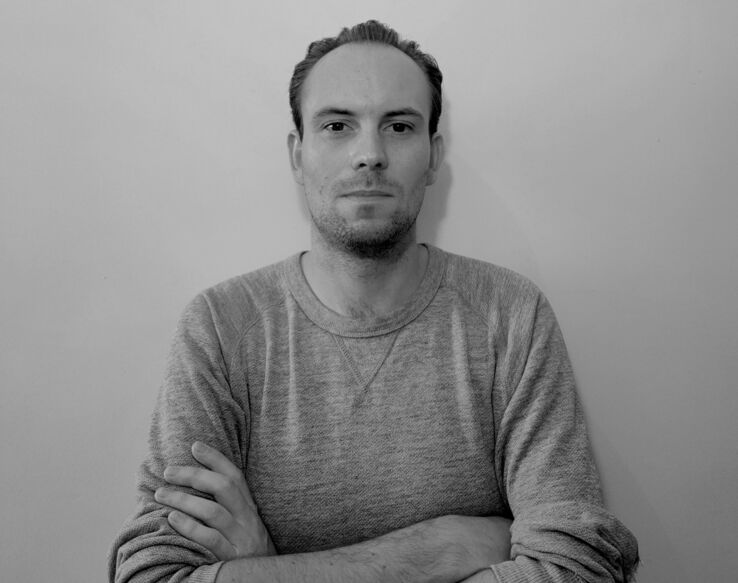
Lancelot Blondeel is a contemporary painter born in 1988. Trained as an engineer, he now works near Paris.
The artist develops a gestural approach, creating a practice conceived in its relationship to movement. Through the body, the painter builds a memory of gesture, leaving imprints and furrows on the support. These singular traces are revealed through the combination of complementary materials: transparent matter, paper, and cotton canvas.
Granting an important place to the circulation of light through his works, the artist questions the way reality presents itself to the eye, exploring the mechanics of the senses and of perception. He draws the viewer into a reflexive position that questions our modes of presence in the world.
Technique & Process
Lancelot Blondeel works with paper, wood, and cotton canvas. He also employs materials that allow light to pass through, such as plexiglas, transparent canvas, and silk paper. The artist paints in acrylics, starting from primary colours and reworking his tones with pigments or additional hues. His technique is characterised by the use of handmade tools — principally scrapers — with the particularity of working flat on a rigid support.
The addition and removal of matter form an integral part of the artist's pictorial practice; he amplifies, concentrates, or refines the layers of paint at precise points across the canvas, guided as much by sight as by touch. This tactile sensitivity during the making is inseparable from the final visual result.
Stylistic Work
In his research into abstraction, Lancelot Blondeel studies gesture and geometry. The gestural approach is conceived in its relationship to movement: "a memory of gesture persists on the canvas." The artist's body is consciously positioned so as to fix a dynamic onto the support.
Compositions are organised around curved lines and asymmetric forms, in which negative space plays an active role: counterweight and breath are the conditions for the legibility of form. The artist favours monochrome or bichrome palettes with marked contrasts; chromatic reduction concentrates attention on matter, depth, and light.
Vision
Lancelot Blondeel begins from a striking observation: we never access reality directly. Cognitive science confirms this: every act of perception, filtered and reshaped by the senses and the mind, is a construction particular to the one who perceives. What we call "seeing" is already a subjective ordering of the world. It is precisely this gap between what is and what is perceived that his works seek to make intelligible. By working with transparency and reflection, the artist constructs situations in which perception itself becomes unstable: the viewer's gaze modifies what it sees. The work does not represent doubt, it produces it.
