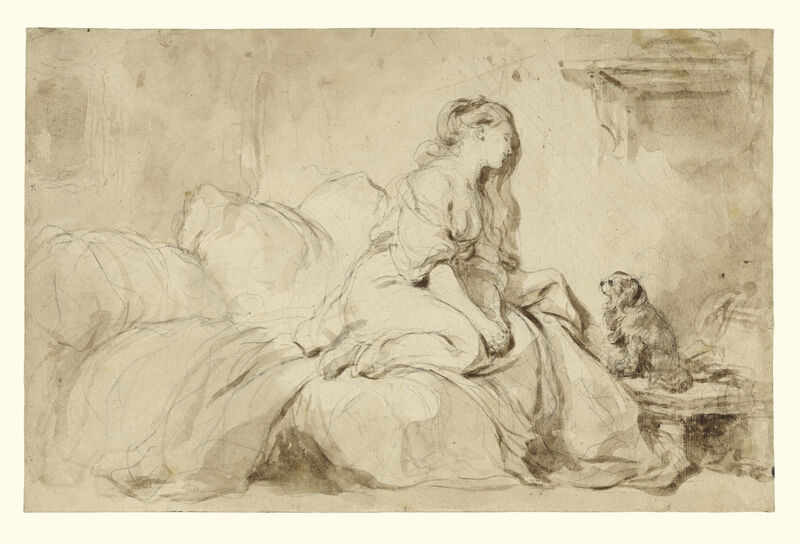
Getty Museum 82.GB.165
Oh! If Only He Were as Faithful to Me, about 1770–75, Jean-Honoré Fragonard (French, 1732 –1806), Brush with brown wash and black chalk, 24.8 × 38.4 cm (9 3/4 × 15 1/8 in.)


Using early modern works from its own collection, the Getty Center introduces visitors to the diverse world of allegories: Virtue and Vice: Allegory in European Drawing opens on March 3 in Los Angeles.
Whether vices and virtues or complex relationships such as friendships, numerous allegories can be found in the visual arts, mostly in the form of personifications. They were used to depict moral concepts, political ideologies, and norms of social interaction in a way that was understandable and easily accessible to viewers at the time. Since the Renaissance, for example, Hercules has been regarded as an allegory of virtuous behavior or even of the exemplary ruler—an interpretation that today's viewers cannot understand without prior knowledge. The Getty Center brings us closer to the past: drawings from its own collection from the 16th to the 19th century illustrate how artists depicted virtuous and vicious behavior. Virtue and Vice: Allegory in European Drawing is on view in Los Angeles from March 3 to June 7.
Allegories, especially those depicting the deadly sins and cardinal virtues, were already widespread in medieval art. During the Renaissance, they experienced a resurgence thanks to a new focus on mythological themes, and finally reached their heyday during the Baroque period, particularly in the decoration of palaces. Allegorical images were understood as warnings against the path of sin or as models for moral behavior. The exhibition at the Getty Center includes works by Agnolo Bronzino, Louis Carrogis de Carmontelle, Pieter Cornelisz. Kunst, Paolo Farinati, Jean-Honoré Fragonard, Jacques de Gheyn II, Jacob Jordaens, Cornelis Ketel, Jacopo Ligozzi, Lorenzo Lotto, Jacob Matham, Jean-Baptiste Oudry, Auguste Rodin, Cornelis Saftleven, and Federico Zuccaro.
As part of the InterNationalgalerie series, the Alte Nationalgalerie invites other institutions to exhibit in its own spaces. Kicking off the series on June 18 is the National Museum in Warsaw with the exhibition Inventing Myths.
Through June 27, Elvira Flamm is showcasing three works from her series Ikonen ohne Namen (Icons without Names) in the Made in Berlin Art Award 2026 exhibition. She was selected as one of 20 artists for the show at the BBA Gallery.