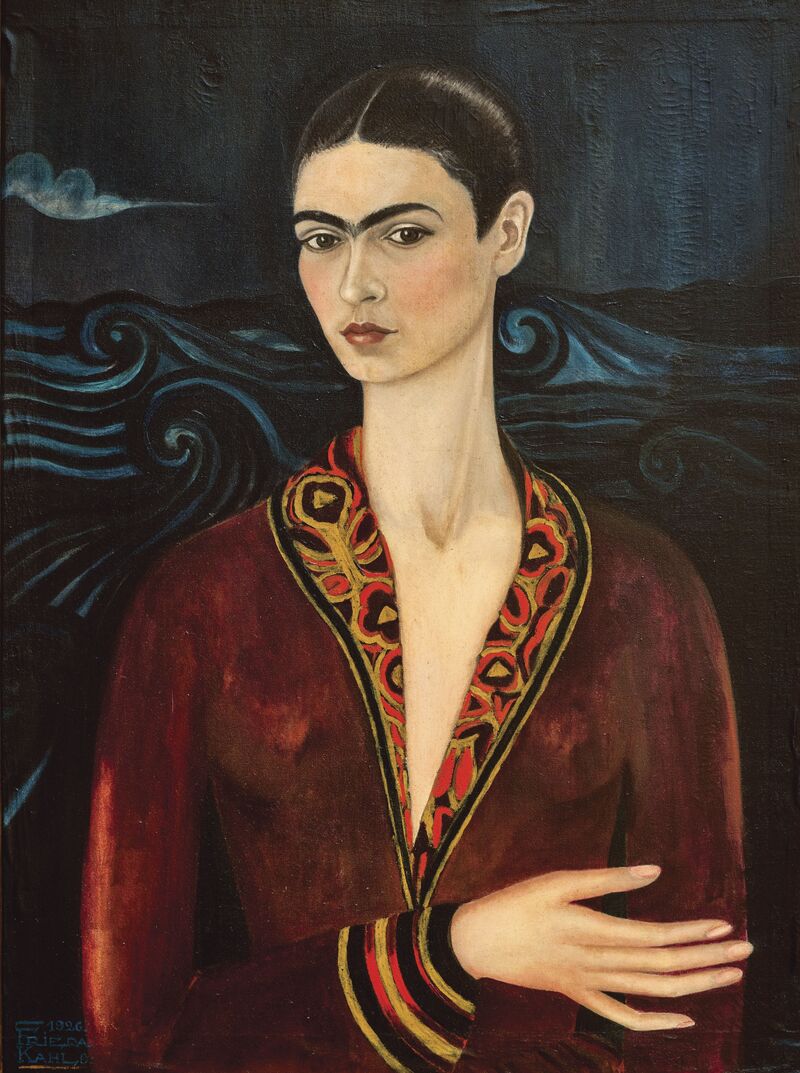
Frida Kahlo, Self-Portrait (With Velvet Dress), 1926. Private Collection.


Frida Kahlo is an influential artist and a cultural phenomenon. The current exhibition at the Tate Modern explores both aspects through 30 works of art and 200 other objects: Frida: The Making of an Icon opens on June 25 in London.
From an unconventional, unknown artist to one of the most famous and a global phenomenon: Frida Kahlo (1907–1954) began painting as a young woman while confined to her sickbed out of boredom following a tragic bus accident. In the 1930s, her work found an audience in surrealist circles and received significant media attention, particularly in the United States. Her painting The Frame (1938) was purchased by the Louvre, yet during her lifetime Kahlo mostly remained in the shadow of her husband Diego Rivera. It was not until several years after her death, in the wake of feminist and postcolonial debates, that she became an international cultural icon—a development to which a biography published in 1983, which has since been translated into 25 languages, also contributed. Today, Kahlo’s face appears on T-shirts, bags, and every conceivable item; her name has been registered as a trademark by her family. With the exhibition Frida: The Making of an Icon, the Tate Modern analyzes both the artist’s work through 30 representative pieces and the development of »Fridamania« with over 200 objects. The show runs from June 25, 2026, to January 3, 2027, in London.
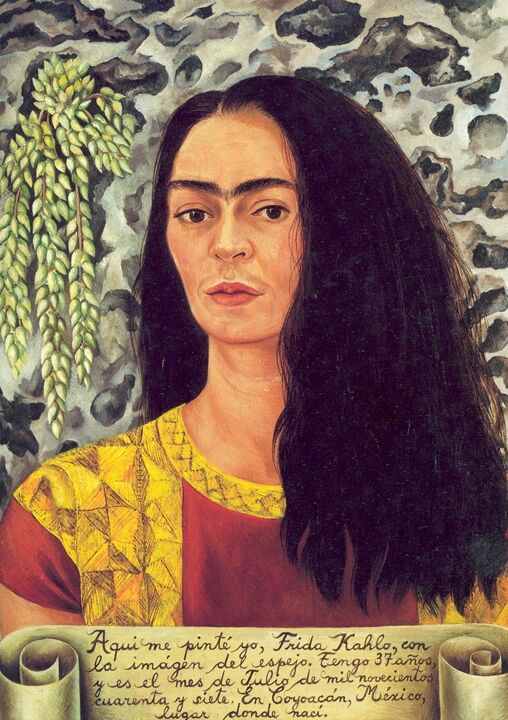
The exhibition itself builds upon the Tate’s last retrospective on Frida Kahlo from 2005: In addition to offering insights into her body of work, the current exhibition explores the artist’s influence on the art world and demonstrates how her work, life, and aesthetic inspired other artists such as Kiki Smith, Judy Chicago, Yasumasa Morimura, and Ana Mendieta. Highlights of the exhibition include Kahlo’s works in which she constructs her own identity and projects it onto the canvas, such as the Self-Portrait (With Velvet Dress) (1926) and Self-Portrait with Loose Hair (1946) shown here. In numerous, often symbolic paintings, the artist explored her Mexican heritage, her queer self-identity, her feminist ideals, and her experiences as a woman with a disability. She died in 1954 at the Casa Azul, now the Frida Kahlo Museum in Mexico City.
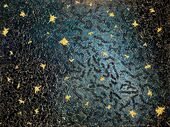
Her work is characterized by rhythmic surfaces that create the impression of movement. Her compositions seem to extend beyond the canvas, capturing moments that are simultaneously slipping away. Art.Salon presents the artist Marketa Hopkins.
As part of the InterNationalgalerie series, the Alte Nationalgalerie invites other institutions to exhibit in its own spaces. Kicking off the series on June 18 is the National Museum in Warsaw with the exhibition Inventing Myths.