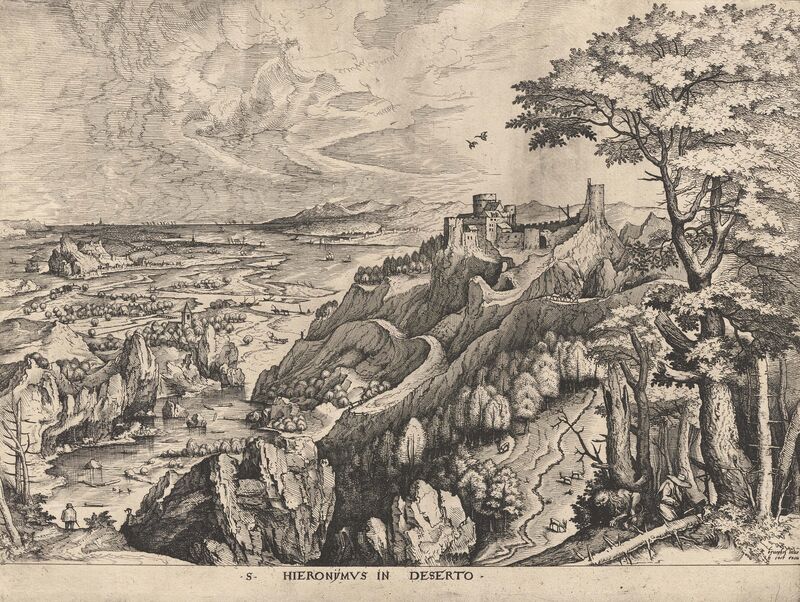
Pieter Bruegel d. Ä., radiert und gestochen von Jan und Lucas van Doetecum, Der heilige Hieronymus in der Wildnis, ca. 1555, Radierung und Kupferstich, 326 x 432 mm, Städel Museum, Frankfurt am Main


Pieter Bruegel the Elder is one of the most famous painters of his time, but his contemporaries primarily valued his idiosyncratic drawings, which served as models for prints. In the exhibition Bruegel Printed, the Städel Museum focuses on this aspect of his work. The exhibition runs through September 20 in Frankfurt am Main.
Pieter Bruegel the Elder (c. 1529–1569) is one of the most significant artists of the 16th century, the so-called Renaissance in the Low Countries. Today, he is best known as a painter of peasant daily life; during his lifetime, he was primarily valued for his unique compositions, which he created as models for prints. The images combine his imagination with precise observations of everyday life; they humorously depict human frailties, the grandeur of nature, and the diversity of social interactions. From today’s perspective, Bruegel’s works offer fascinating insights into the social value systems of his time. In the exhibition Bruegel Printed, the Städel Museum presents around 60 prints, about half of which come from its own collection. Loans were provided by, among others, the ALBERTINA in Vienna and the Staatliche Graphische Sammlung in Munich. The exhibits also include Dutch engravings after Frans Floris, Lambert Lombard, and Raphael. The exhibition runs through September 20 in Frankfurt am Main.
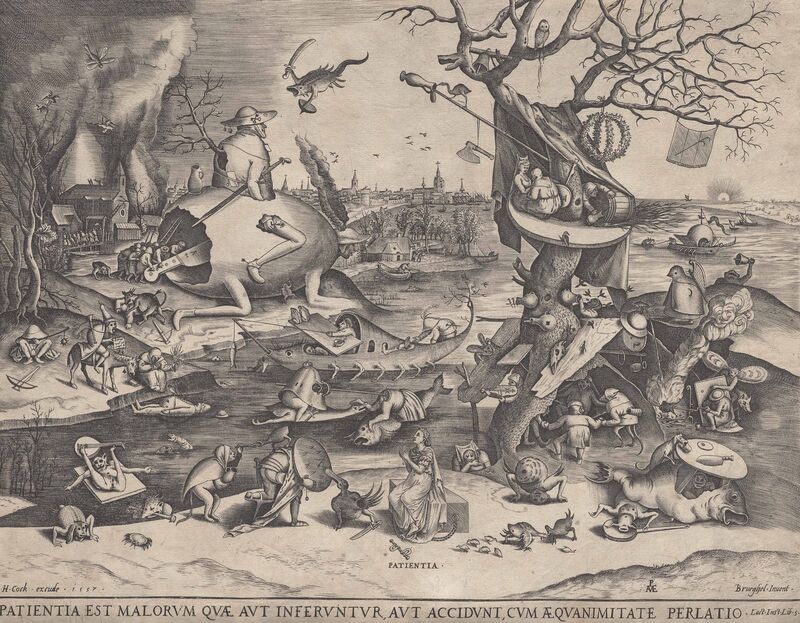
Pieter Bruegel the Elder became a master painter in 1551 and traveled to Italy for several years, where he focused particularly on studying landscapes. One of his major influences was Hieronymus Bosch (c. 1450–1516), whose impact is particularly evident in Bruegel’s early work. Among Bruegel’s best-known works today are the paintings Netherlandish Proverbs (1559) and The Tower of Babel (1563). His sons, Pieter Brueghel the Younger (1564–1638) and Jan Brueghel the Elder (1568–1625), were also significant painters of their generation. Contrary to earlier assumptions, they were not directly trained by their father due to his early death.
Around 1500, woodcut and copperplate engraving developed into distinct art forms: Drawing on works from its own collection, the Cleveland Museum of Art presents the exhibition The Renaissance Engraver at Work. The exhibition runs through November 1 and also features extremely rare prints.
In a special exhibition, the National Gallery of Ireland presents drawings from its own collection: In Rembrandt to Matisse – A Celebration of European Works on Paper, visitors can trace the evolution of styles and favored motifs over the centuries. The exhibition runs through December 6 in Dublin.