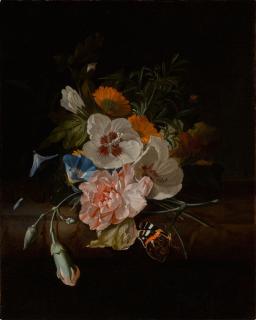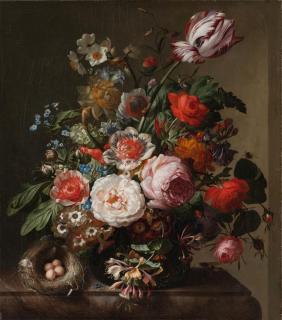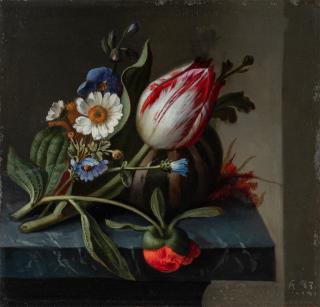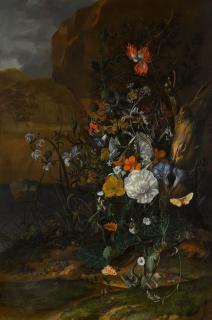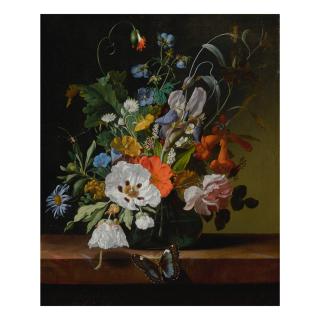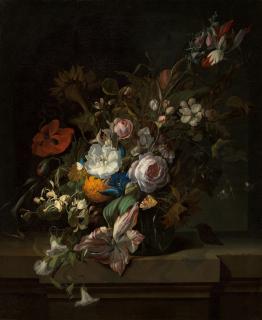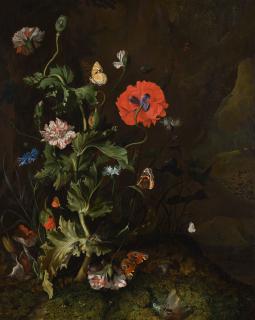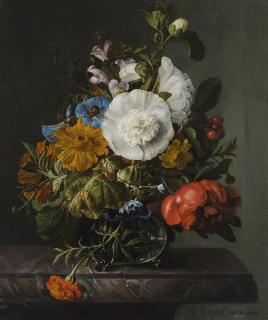


She was a famous painter throughout Europe during her lifetime and her works fetched top prices: Rachel Ruysch (1664-1750), who spent almost her entire life in Amsterdam, was a sensation of her time. The still life painter set new standards with her paintings: she painted her flowers, insects and reptiles so vividly that she surpassed the work of other painters. She often presented her still lifes against a black background, which emphasized the luminosity of the flowers, and influenced countless colleagues with this combination. Ruysch was also one of the first painters to incorporate flowers from South America and Africa, such as passion flowers and cacti, into her work. As global trade routes expanded, thousands of new species found their way into Dutch botanical gardens. Ruysch's still lifes have a high decorative value, but also depict new scientific findings and developments such as colonial expansion. Most flower still lifes carry hidden meanings, often religious ones: The flowers, butterflies, bees, lizards and flies are important Christian symbols that were immediately accessible to the viewers of the time. The Museum of Fine Arts Boston is now showing the painter's first major solo exhibition: Rachel Ruysch: Artist, Naturalist, and Pioneer runs from August 23 through December 07.
In addition to the 35 works by Rachel Ruysch, paintings by other female artists are also on display. They create the right context and allow comparisons. The artists include Ruysch's sister Anna Ruysch, Maria Sibylla Merian and Alida Withoos. The works of art come from numerous public and private collections in the USA and Europe. Ruysch had high standards for her work and took a lot of time for her paintings. She painted a maximum of two paintings a year. This did not change when she became famous and the demand for her works rose sharply, which is why there are comparatively few paintings by her. As a woman, she was denied access to a painters' guild and thus the right to open a workshop. Today, her paintings can be found in the National Gallery in London, the Kunsthistorisches Museum in Vienna, the Rijksmuseum in Amsterdam and the National Gallery of Victoria in Melbourne, among others.
The exhibition was created in collaboration with the Alte Pinakothek in Munich and the Toledo Museum of Art, Ohio, where it was previously shown.