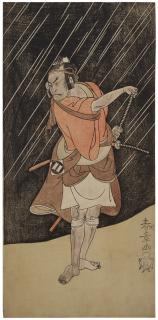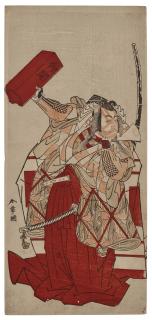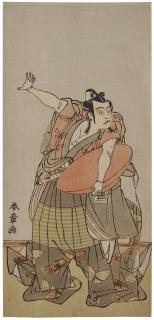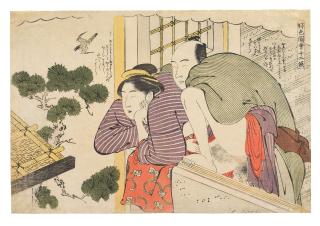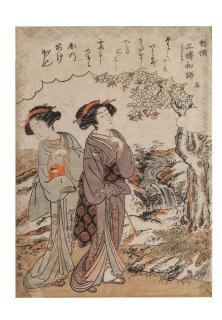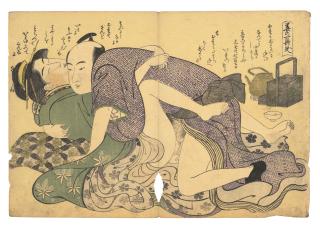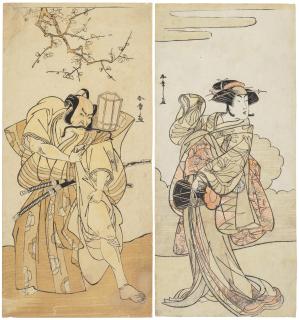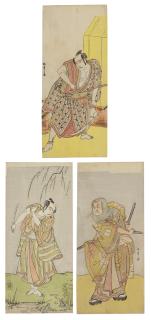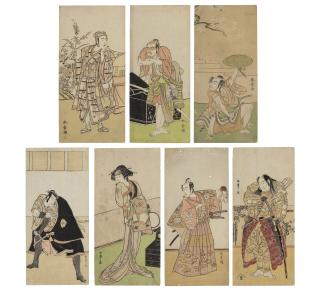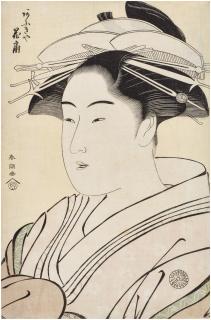


At a time when the Kabuki theater district in present-day Tokyo played a major role in local society, the Japanese woodblock print artist and painter Katsukawa Shunshō (1726-1792) founded the Katsukawa School. Prominent artists, including Katsukawa Shunkō (1743-1812) and Shun'ei (1762-1819) in addition to Shunshō himself, depicted the dramas of Kabuki theater in many prints and portrayed the Kabuki actors famous in the 18th century. The exhibition The Golden Age of Kabuki Prints at the Art Institute Chicago is dedicated to these prints and features works by all three artists, which are drawn from the Art Institute's Katsukawa School collection of more than 700 prints. Because the Institute's gallery will be closed April 11-15, 2022, the show of works will be presented in two cycles: The first will begin on January 15 and end on April 10, and the second will begin on April 16 and end on June 26.
The Kabuki theater district in 18th century Edo (present-day Tokyo) was considered a focal point of urban life in its time. People could escape their controlled daily lives and watch dramas with themes such as murder, revenge, disgrace, jealousy, or redemption, which were often based on historical events or myths. In addition to drama, Kabuki theater was characterized primarily by the sometimes exaggerated and highly stylized postures, movements, hand gestures, and facial expressions. In particular, the »mie«, an emphatic pose that actors took at an important moment in the action, played an essential role. Often made up of a scowl or a dramatic distortion of the face with partly squinting eyes, it was usually supported by a specific posture as well as particular positions of hands and limbs and was therefore considered a popular motif for prints.