Getty LA: (Re)Inventing the Américas: Construct. Erase. Repeat.

Contrary to a European Fairy Tale

Beginning August 23, the Getty Center clears away the European view of the history of the American double continent and instead gives space to other perspectives. (Re)Inventing the Américas: Repeat. Erase, Construct also questions its own collection.

August 23, 2022
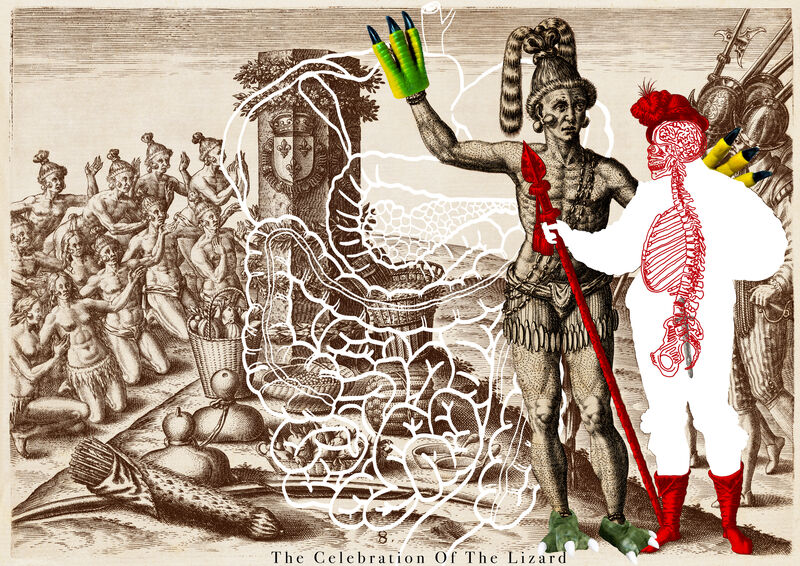
The Celebration of the Lizard, 2022, Denilson Baniwa (Amazonian and Brazilian, b. 1984), Digital intervention based on “Columnam à Praefecto Prima, Navigatione Locatam Venerantur Floridenses”, from Jacques Le Moyne de Morgues (French, ca. 1533–before 1588), Brevis Narratio Eorum Quae in Florida Americæ Provincia Gallis Acciderunt (Frankfurt, 1591), pl. 8

Getty Research Institute, 87-B24110, Courtesy the artist © Denilson Baniwa
The Celebration of the Lizard, 2022, Denilson Baniwa (Amazonian and Brazilian, b. 1984), Digital intervention based on »Columnam à Praefecto Prima, Navigatione Locatam Venerantur Floridenses«, from Jacques Le Moyne de Morgues (French, ca. 1533–before 1588), Brevis Narratio Eorum Quae in Florida Americæ Provincia Gallis Acciderunt (Frankfurt, 1591), pl. 8

The Getty Center in L.A. opens August 23 with (Re)Inventing the Américas: Repeat. Erase, Construct, an exhibition that seeks to restage the European view of the history of the American double continent from the ground up. On view through January 8, 2023, it radically explores the creation of mythologies that emerged during the conquest of the American continents, revealing the power that legends and »paradisiacal concepts« exercised in defining the two »Americas.«

The engravings, etchings, lithographs, and woodcuts on view also question the Getty's own collections from the colonial period and the 19th century. »They take a hard look at European representations of the American continents,« said Mary Miller, director of the Getty Research Institute. »It [the exhibit] shows that the Americas have been reinvented using European conventions and ideas.«

This time, in order to create an image that illustrates more than just the perception of the Americas from the European perspective, this exhibition features contemporary Brazilian indigenous artist Denilson Baniwa. »Our collections illustrate the construction of an image of the Americas based on the European perspective,« says Idurre Alonso, curator at the Getty Research Institute. »Therefore, it was important for me to analyze this European perspective and counter it through a multi-layered presentation of the objects in the exhibition. To this end, I collaborated with Denilson Baniwa and our local Latin American and Latinx community. Their voices became part of the exhibition's narrative and questioned the persistence of certain ideas.«

Baniwa's urban interventions represent indigenous people, examine America's colonial past, and counter stereotypical representations of their culture. His work enriches the exhibition with unflinching prints and drawings.

The exhibition is divided into five themes: the allegorical construction of the Americas, the natural wealth of the Americas, the construction of archetypes, the political images of conquest, and the work of European travelers.Art.Salon

Chimborazo Seen from the Plain of Tapia, Louis Bouquet (French, b. 1765–1814) and Jean Thomas Thibault, (French, 1757–1826), Engraving in Alexander von Humboldt, Vues des Cordillères, et monumens des peuples indigènes de l’Amérique (Paris, 1810), between pp. 200 and 201
Getty Research Institute, Los Angeles (85-B1535)
Chimborazo Seen from the Plain of Tapia, Louis Bouquet (French, b. 1765–1814) and Jean Thomas Thibault, (French, 1757–1826), Engraving in Alexander von Humboldt, Vues des Cordillères, et monumens des peuples indigènes de l’Amérique (Paris, 1810), between pp. 200 and 201

Dive deeper into the art world

Los Angeles County Museum of Art

With this exhibition, the Los Angeles County Museum of Art examines how part of its collection developed: Collecting Impressionism at LACMA opens on December 21.

December 20, 2025
Augsburg, Schaezlerpalais

On the 500th anniversary of Jakob Fugger's death on December 30, the Schaezlerpalais is commemorating him as a patron of the arts: the wealthy merchant family commissioned numerous artists of their time. The exhibition Art’s Rich Heritage: Jakob Fugger and his Legacy runs until April 12, 2026, in Augsburg.

December 17, 2025