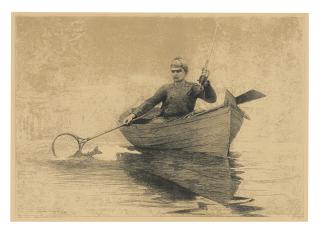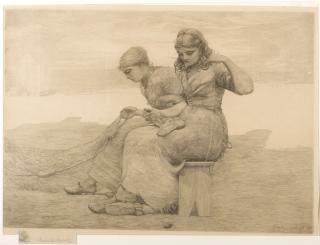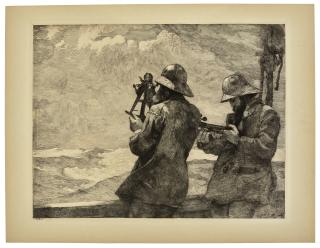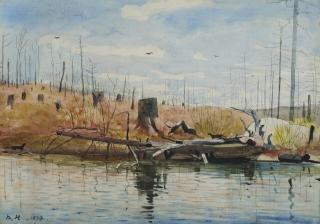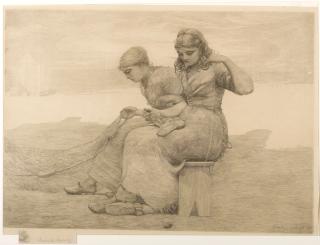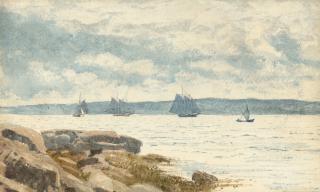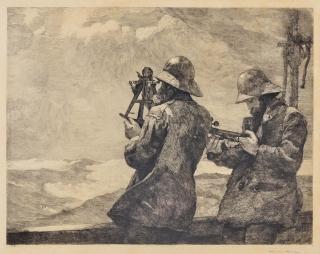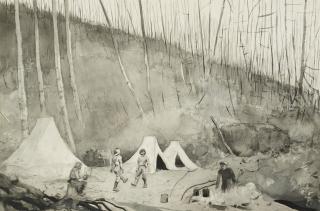


In 1894, the Museum of Fine Arts, Boston was one of the first museums to acquire an oil painting by Winslow Homer (1836-1910). A few years later, Leaping Trout (1889) became the museum's first watercolor by the painter, who was one of the most famous in New England and had lived in seclusion in Prouts Neck, Maine, since the 1880s. Over the course of the 20th century, the museum expanded its Homer collection and now owns the largest collection of the artist's watercolors, with almost 50 works, as well as 11 oil paintings. Homer proved to be technically skilled and experimental. With innovative techniques, he succeeded like few others in capturing the fleeting nature of moments while making optimal use of the color and form-giving characteristics of watercolor. For the first time in almost 50 years, the Museum of Fine Arts Boston is presenting the light-sensitive artworks on such a scale, along with selected oil paintings, drawings, and prints. Of Light and Air: Winslow Homer in Watercolor will be on view from November 2, 2025, to January 19, 2026.
As a young man, Winslow Homer worked at Harper's Weekly, where he made drawings from photographs that were then used as the basis for woodcuts to print the images in the newspaper. Homer's flair for dramatic and poignant moments was evident early on, and he honed his skills in private painting lessons. During the 1860s, he developed from an illustrator into an established painter. His painting Prisoners from the Front (1866) was exhibited at the Paris Salon in 1866 and received a great deal of attention. Stays in Paris and England had a major influence on his painting style and choice of subjects, resulting in noticeable changes in his oeuvre. Homer was one of the artists who brought the ideas of Impressionism to the United States. Among his best-known works is The Life Line (1884), which depicts a sea rescue using the then-novel trouser buoy. Homer's former home and studio was designated a National Historic Landmark in 1996.