
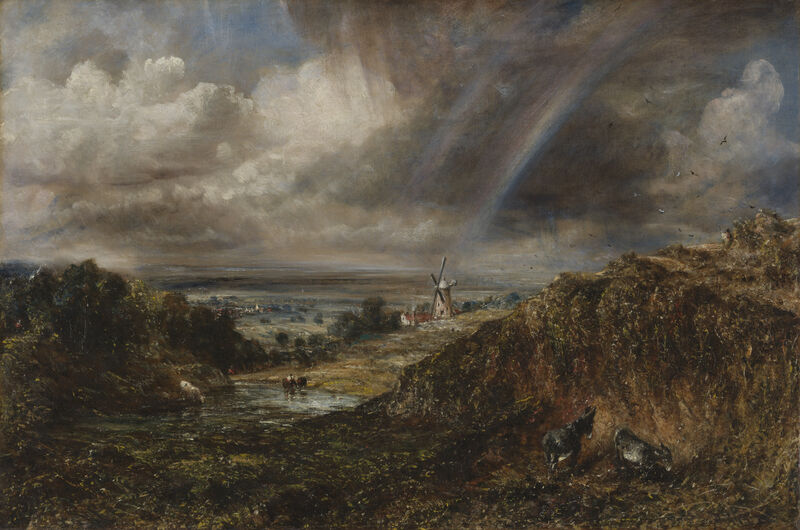
Image courtesy of Tate.
John Constable, Hampstead Heath with a Rainbow, 1836


Two important British painters can now be seen side by side again, as they were during their lifetimes: In Turner and Constable, Tate Britain traces the rivalry between the two artists and offers detailed insights into their working methods. The exhibition opens on November 27 in London.
Like the battle between water and fire: this is how some 19th-century art critics described the rivalry between John Constable (1776-1837) and William Turner (1775-1851). Both painters devoted themselves to landscape painting and used it to reflect emotions and the changing world, especially as a result of the onset of industrialization in England. Both Constable's and Turner's works were considered unusual, but their approaches were very different: Turner focused on the use of light, even venturing into abstraction in his later work, and undertook various journeys, while Constable painted places he knew well and devoted himself entirely to nature and the impressions it left on him, regardless of painterly conventions, with extreme attention to detail. Tate Britain now takes visitors back to the early 19th century, reviving the old rivalry and exploring the painters' inspirations and working methods through sketchbooks and personal items. Turner and Constable can be seen in London from November 27, 2025, to April 12, 2026.
Both painters had a major influence on subsequent generations: Turner is considered, especially because of his late work, to be a leading inspiration for the Impressionists and modern art as a whole. Constable, whose work was much more popular in France than in England, was a role model for the Barbizon School, which was central to the emergence of realism in the 19th century. The loose group includes Jean-François Millet (1814-1875), Édouard Manet (1832-1883), and Edgar Degas (1834-1917), among others.
Art for the harmonious coexistence of the global population: At the Haus der Kunst in Munich, Argentine artist Tomás Saraceno presents visions for new forms of living together. The exhibition Tomás Saraceno. Ancestral Futures opens on July 17.
A unique body of work: Tate Modern is presenting the Cuban artist Ana Mendieta with over 150 works, including films, installations, and rarely seen paintings. The exhibition of the same name opens on July 15 in London.