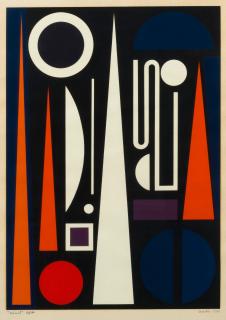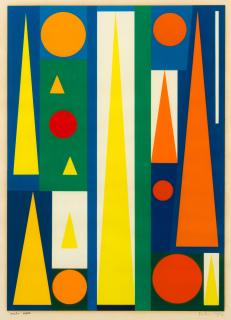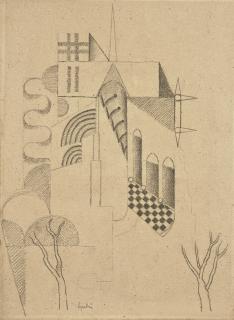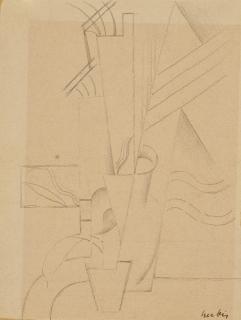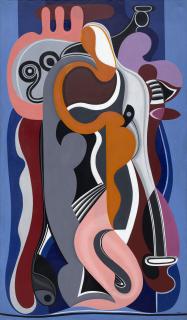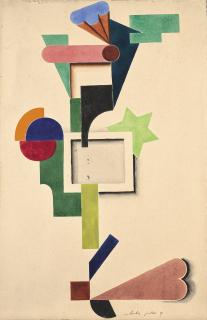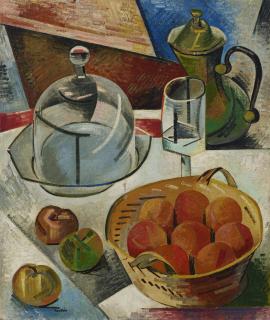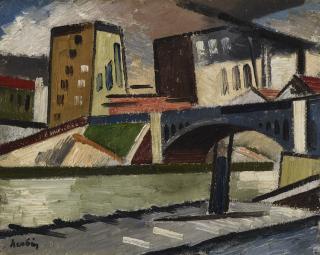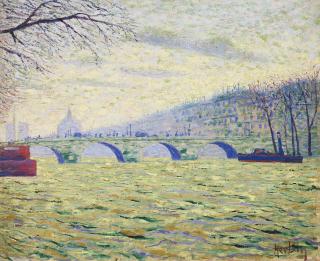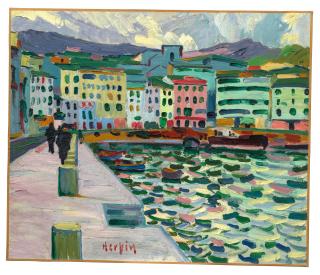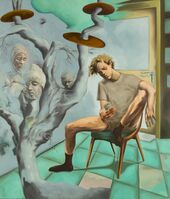


Characterized by changes in style, his trademark is his luminous, harmoniously combined power of colour: Auguste Herbin (1882-1960) is considered a revolutionary of modernism and one of the founders of abstraction in France. As a young painter, he mainly created late Impressionist landscapes and portraits, followed by a brief Fauvist phase. As early as 1909, he was one of the first to paint Cubist pictures and contributed to the success of this revolutionary art movement. Cubism, which other painters tended to keep in earthy colors, found a new, strong-colored expression in Herbin's work. In the 1930s, Herbin fully committed himself to abstraction, which he discovered for himself in the wake of Cubism, and, driven by an urge for renewal, was a leading voice of concrete and kinetic art as well as Op Art in France in the post-war period. The Lenbachhaus in Munich is presenting around 50 important works that trace the painter's development in the exhibition Auguste Herbin, which is open until October 19.
Herbin also worked outside of painting: during the First World War, he designed camouflage patterns for airplanes, after which he developed a completely abstract, geometric vocabulary of forms for decorative wooden objects for the first time. However, these painted reliefs met with incomprehension even from the most well-meaning critics. On the advice of art collector Léonce Rosenberg, Herbin temporarily turned to New Objectivity at the end of the 1920s, before he, briefly inspired by Surrealism, moved abstraction to the center of his oeuvre. In the 1940s and 1950s in particular, Herbin exhibited throughout Europe and also in the USA, Argentina and Brazil – he was an artist of international standing. Today, his works can be found in numerous private and public collections, including the Kröller-Müller Museum in the Netherlands and the Matisse Museum in France.