Foto © Hasso Plattner Collection
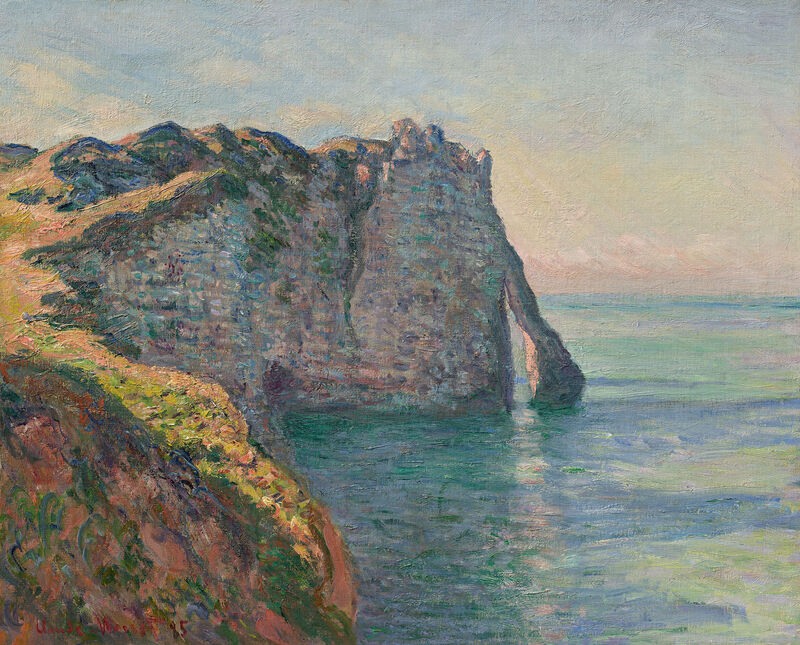
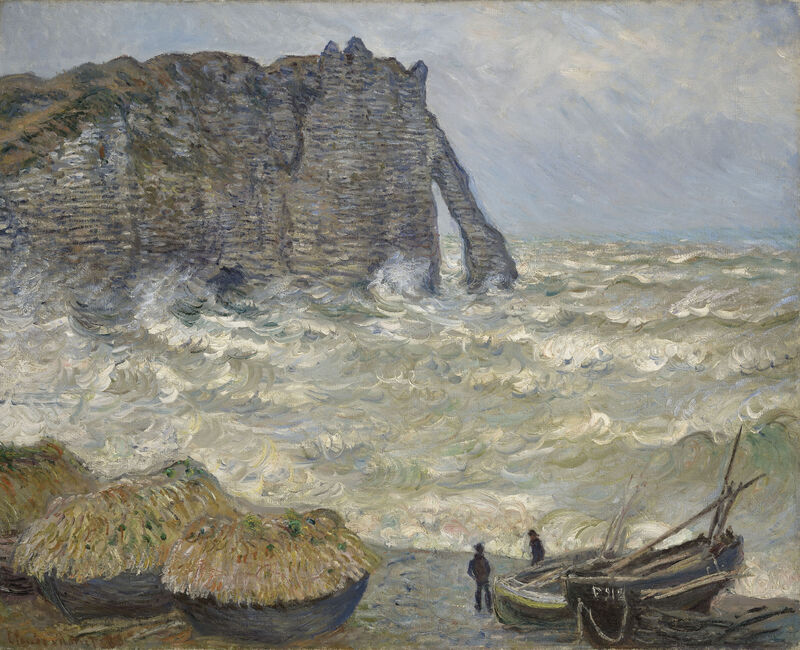
Claude Monet, Steilküste von Aval, 1885, Öl auf Leinwand, 65 x 81 cm


With 24 works by Claude Monet and a total of around 170 paintings, drawings, and photographs, the Städel Museum explores the cliffs of Étretat in Normandy, a coastal landscape that has fascinated numerous artists. Monet on the Normandy Coast. The Discovery of Étretat can be seen in Frankfurt am Main from March 19.
Since the Romantic period, the cliffs of Étretat, originally a fishing village in Normandy on the Atlantic coast, have served as a basis for drawings and paintings by artists. The three rock arches Porte d'Amont, Porte d'Aval, and Manneporte in particular fascinated artists, who found beauty but also menace in the rocky landscape. With the increase in tourism around 1850, Étretat developed from a fishing village into a popular seaside resort and a meeting place for artists and the Parisian bourgeoisie. The young painter Claude Monet (1840-1926) was also enthusiastic about the region and depicted the rock gates in numerous paintings. Impressed by the constantly changing light and weather conditions, he began to paint Étretat in series of motifs. This working method later became Monet's trademark and developed into a central element of Impressionism. For the first time, an art exhibition is now dedicated to the myth of Étretat, in which Monet played a decisive role: Monet on the Normandy Coast. The Discovery of Étretat can be seen at the Städel Museum in Frankfurt from March 19 to July 5.
The exhibition presents a total of around 170 works of art, 24 of which are by Monet alone. Starting from other historical positions such as Eugène Boudin, Gustave Courbet, Alphonse Davanne, Eugène Delacroix, Eugène Le Poittevin, Henri Matisse, and Félix Vallotton, the exhibition draws a line to contemporary works such as the photographs of Elger Esser. Together, the works illustrate the enduring fascination that this place continues to exert on artists and creative minds to this day. The loans come from the Berlin State Museums, the Fitzwilliam Museum in Cambridge, the Metropolitan Museum of Art in New York, the National Gallery of Canada in Ottawa, and the Musée d'Orsay in Paris, among others.
Born in Paris, Monet broke away from the realistic painting he had learned as a young man during the 1860s and increasingly painted in an Impressionist style. In 1870, Monet fled the Franco-Prussian War to London, where he studied paintings by the famous William Turner (1775-1851), whose light-dominated paintings had a great influence on Monet. In the years following the first Impressionist exhibition in Paris in 1874, financial success slowly began to materialize, enabling Monet to continue his artistic experiments.
Paintings and sculptures on social conditions: Stefan Stichler creates works open to interpretation based on everyday observations and his own experiences. In the exhibition Bullet The Blue, he presents recent works shaped by current events. The vernissage begins on June 21 at 3:30 p.m. at Kunstraum EN in Ennepetal.
She is the first East German artist to receive a solo exhibition at the Gropius Bau in Berlin: The show Gabriele Stötzer: Participating and Not Remaining Silent, opening on June 19, presents around 150 works by the versatile and experimental artist, who will receive the Goslar Kaiserring in 2026.