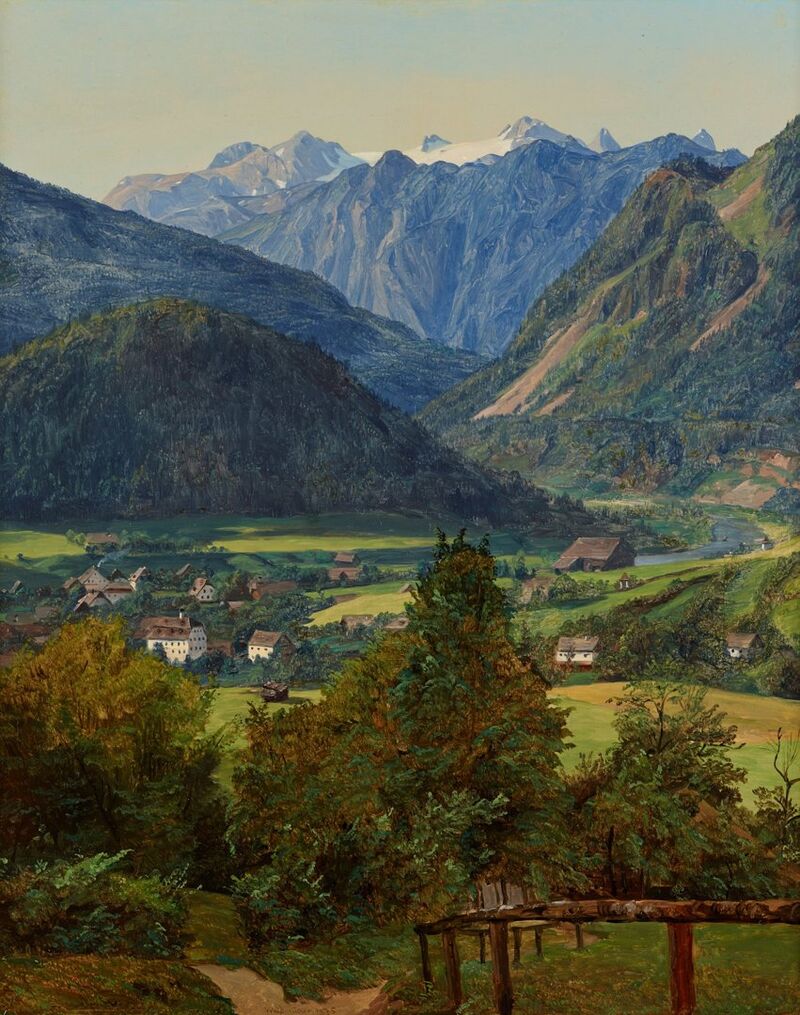


This landscape exhibition begins with a self-portrait—not to show who painted the landscapes, but to highlight the breadth of his work: The Austrian painter Ferdinand Georg Waldmüller (1793–1865) is known today primarily for his landscapes, but during his lifetime he was celebrated for his genre paintings and, particularly in aristocratic circles, for his portraits. Waldmüller lived during the Biedermeier period, an era that primarily shaped regions of present-day Germany and Austria, but he cannot be described as a Biedermeier painter. »[…] his work […] can be both moralising and unflinchingly honest,« explains Sarah Herring, who curated the exhibition at the National Gallery together with Dr. Arnika Groenewald-Schmidt. Waldmüller was committed to the truth of nature; his landscapes are characterized by photographic clarity, lifelike lighting, and intense colors. They resemble Biedermeier paintings only at first glance. The painter’s first exhibition in the United Kingdom opens in London on July 2: Waldmüller: Landscapes runs through September 20. The exhibition was organized in collaboration with the Belvedere Museum in Vienna, which also provided most of the paintings on display on loan.
Waldmüller received a classical academic education in Vienna. He taught himself landscape painting—a genre that only gained prominence in what is now Germany and Austria during the 19th century—by creating copies of 17th-century Dutch landscapes, such as those by Jacob van Ruisdael and Meindert Hobbema. Waldmüller’s paintings from Sicily, which he visited every year between 1844 and 1846, hold a special place in the current exhibition. There, he was fascinated by the extraordinary light in interplay with the Mediterranean landscape and the ancient ruins. Waldmüller advocated for the study of nature outdoors—still quite uncommon in his day—which he preferred to copying the Old Masters. This brought him into conflict with the Academy, which eventually revoked his studio space and, a few years later, suspended him from his post as a full member of the Academy. Financial difficulties subsequently marked his life, but the great acclaim his works received at international exhibitions, including ones in London and Cologne, ensured he enjoyed a successful final chapter of his life.