Interview: Photographer Elitza Nanova

»With the camera, I can lend permanence to the ephemeral«

Bringing time to a standstill with photography: Berlin-based photographer Elitza Nanova not only captures the dynamics of dance, but also her fascination with fleeting moments for eternity. In an in-depth conversation, she provides deep insights into her practice. The interview was conducted by Mario Stumpfe.

June 05, 2025

Her photographs offer glimpses of reality that remain hidden to the human eye: Elitza Nanova has mastered dance photography and her elegant images immediately attract attention. In this interview, she explains in detail how long she has been involved in photography, how she came to dance photography and what other areas she works in.

The interview was conducted by freelance journalist Mario Stumpfe in May 2025:

Elitza, you have been a photographer in Berlin for some time now, but you were born and raised in Bulgaria. You studied art and cultural studies at Berlin's Humboldt University and later worked as a graphic designer for a long time. It doesn't sound like a straightforward path. Have images always been important to you?

Pictures have been with me all my life. I was lucky enough to grow up in an art-loving household in Sofia, where there were art albums, books and conversations about art – despite the socialist economy of scarcity. As an art student in Berlin, I learned to analyze pictures, as a graphic designer I had to interact with other people's and my own photos, as a photographer I often stand in front of my many photos and have to make a selection, judge them and choose the best ones.
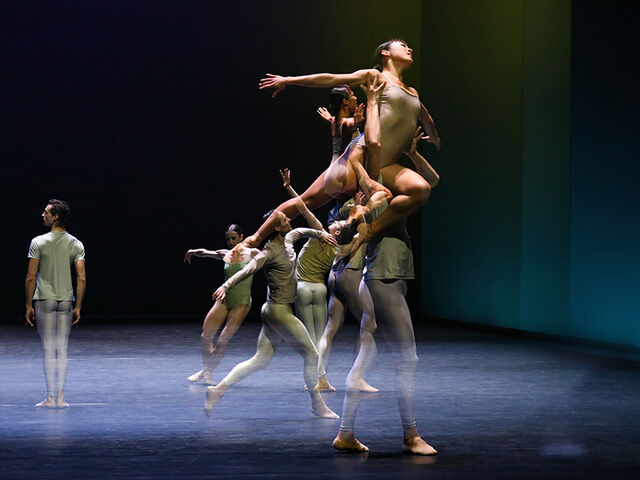
DAWSON | VOICES, 2021 (Staatsballett Berlin) Mehrfachbelichtung

When did you discover photography?

I took my first course at the adult education center in Berlin when I was 18 and then set up a laboratory for analog black and white photography. Unfortunately, photography only remained latent in my life for a long time. I can't describe it, but somehow I was afraid to throw myself fully into it. In my student days, I pursued it as a hobby, then as a freelance journalist I illustrated my newspaper articles with my photos, later – as a graphic designer – I used my photos in projects, and finally I took great pleasure in capturing the development of my children.... But for a long time I wasn't fully committed to photography.

That changed when I started dancing at the age of 40 and through dance many blockages fell away and many dormant life projects came to light. Personal contact with dancers and sharing in their work also inspired me to intensify my photography. It was clear to me that at my age I wouldn't be able to reach any heights as a dancer, but that I could certainly live out my fascination for dance and movement through the camera. I developed my skills in dance photography and experimented with a wide variety of photographic techniques.

After my first exhibition »Fascination of Movement« in 2020, I was confronted with the question of whether I wanted to continue practicing photography as a craft or work more artistically. Well, the second suits me better.

SCHNEE III, 2024 (Tänzer: Carlos Frevo), Einfrieren von Bewegung

Why did you choose photography as a means of expression?

My head was always full of images. Even as a child, I used to spend long evenings in bed with my eyes closed, imagining, producing images, making up the world the way I wanted it to be. I also loved painting and drawing, but I am very impatient and need a faster medium to realize my ideas. What's more, I'm particularly interested in fragile and fleeting conditions, such as movement, water and light moods. With the camera, I can lend permanence to the ephemeral.

I believe that if you approach the subject from a depth psychology perspective, photography was a remedy for a great fear of loss in me. This fear arose when I came to Berlin in the 1980s, when a whole world – Bulgaria – was lost to me. But the general human fear of our transience also plays a role here. For me, the camera is a kind of magic wand that allows me to control time and, if I want, to stop it. In my exhibition »Time – Structure« (2024), I illustrated this phenomenon using motion photography – I use short exposure times to freeze time, long exposure times to show the traces of movement and duration, multiple exposures to show simultaneity and stroboscope effect photography to dissect the moment into fragments and capture them in a single image. I accept the challenge of using a static medium such as photography to depict movement and allow it to continue to have an effect.

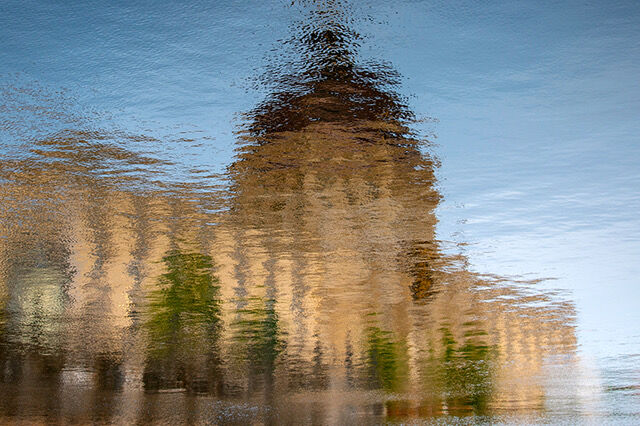
Nevertheless, it is not only the fear of loss and transience that drives and determines my photography. It is also a great pleasure to capture transformations and changes. In my series »Berlin as water reflection«, I photograph the »eternal« buildings on the Spree – the palace, the cathedral, the Pergamon Museum, etc. – in many variations and manifestations as transient water reflections. And in dance pictures, such as »In the flow of time«, I capture traces of movement – unique moments that no one else has seen or can see in this way.

What are you currently photographing?

Since I've decided on artistic photography, I'm not so thematically fixed. I pay more attention to the »inner thread« and where it leads me. After working intensively with movement from 2012-2023, I've been fascinated by water since 2024. The series »Berlin as a reflection of water« is a »work in progress« and will perhaps continue, but a new series has emerged from the observation of water – »Abstract water paintings«. Here, too, water becomes my canvas, its surface structures become brushstrokes and lines, the reflections on it become color spots and patterns. Only here »everything is out of joint« – real objects such as houses, boats and bridges lose their representational nature and become abstract photographs.

BERLINER SCHLOSS III, 2025 (Serie: „Berlin als Wasserspiegelung“)

What kind of photography do you like? Your water pictures, for example, move between many areas of photography – nature photography, architectural photography, landscape photography, street photography, abstract photography – but also between the media of photography, painting and graphics.

My preoccupation with images and art history has sensitized me to many art movements and styles. I choose the means unconsciously. Only in retrospect do I realize – »oh, that's impressionistic«, or »that belongs to the Bauhaus« or »oh, I didn't know I would ever be a landscape painter«. In principle, with every photo I take, I look for something special, something unique, something »familiar« that no one else has seen, even though the original »motif« is there for everyone to see and is very real.

And, I really enjoy exploring the boundaries between photography and other media.

You have already had 4 solo exhibitions and one group exhibition. Are you planning a new exhibition for 2025?

Yes, 3 exhibitions are provisionally planned for 2025.

From June 4 to 28, 2025, I am taking part in a group exhibition with the charming title »I found a way to make you smile«, in which 38 works aim to make the viewer smile in times when there is little to laugh about.

In October, I will have a solo exhibition where I can present different facets of my photography.

An exhibition in a public space is planned, but not yet ready.Art.Salon

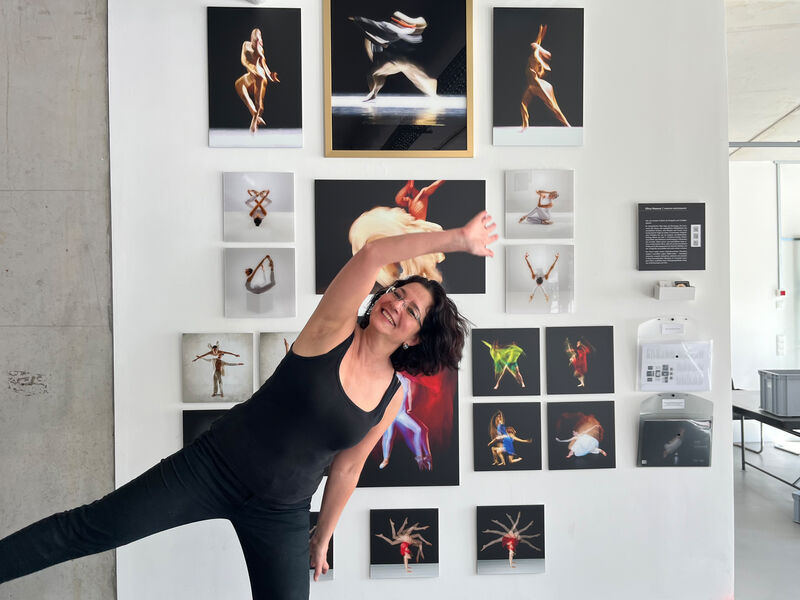
Elitza Nanova by Zuza Różańska
Elitza Nanova, Photo: Zuza Różańska
Deep dive:

Dive deeper into the art world

New York: Helene Schjerfbeck at the Metropolitan Museum of Art

She is a national heroine in Finland, but has only become known internationally in recent years: Helene Schjerfbeck fascinates with her original, simple style. For the first time, a major museum in the USA is presenting her work: Seeing Silence: The Paintings of Helene Schjerfbeck opens on December 5 at the Metropolitan Museum of Art in New York.

December 05, 2025
Australia: Fremantle Biennale with Raki Nikahetiya

From November 13 to 30, the Fremantle Biennale took place in Australia near Perth, focusing on site-specific contemporary art. Among the exhibiting artists was Raki Nikahetiya with a sensory installation about the intertwining of identity, displacement, and home.

December 03, 2025