Provided by the artist.
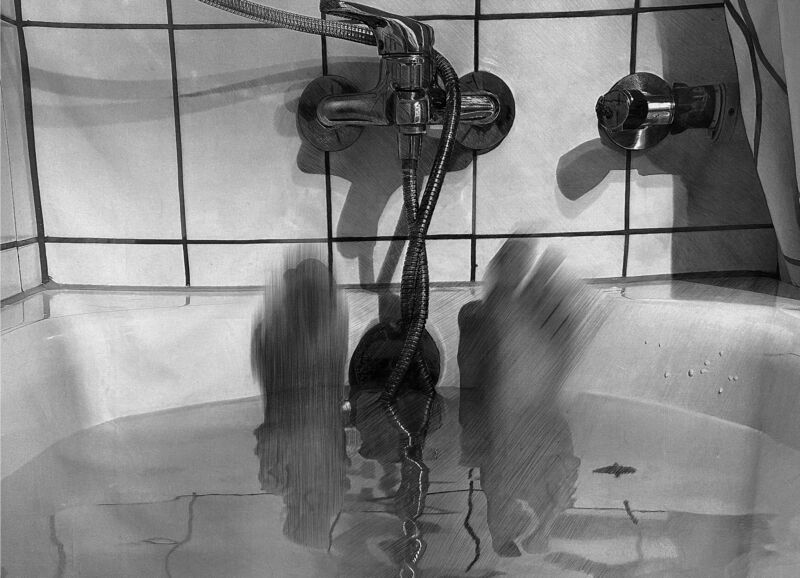
Kim Kluge, Restless legs, 180 x 130 cm, Graphitzeichnung auf Leinwand, 2025


From felt to digital image processing: the intermedia painter Kim Kluge combines digital and analog design possibilities to develop a new technique, painting with a felting needle. She is currently working on a series of large-format graphite drawings. Art.Salon interviewed the artist about her work.
A plea for tradition in the digital world: in her works in the on the move series, Kim Kluge combines digital forms of expression with artistic interpretations of traditional craftsmanship. The artist develops photographic sketches, which she then processes digitally. She then executes the work in an extremely labor-intensive technique in felt on canvas by repeatedly piercing the wool threads with a felting needle until they become matted and bond with the canvas. The resulting images of people and objects are blurred, allowing different perspectives on the work depending on the viewer's proximity and distance. Kluge combines digital techniques, whose developments cannot be ignored, with traditional skills that should not be forgotten. With her work, the artist questions thinking geared towards mere economic progress. Kluge found the right symbol in felt, one of the oldest materials in human culture, which was originally used for clothing.
Kluge has been working with her new felt technique since mid-2023. The intermedia painter and conceptual artist has previously explored various materials and thematic complexes, such as the essence or synthetic portraits, which are explained in more detail below. With her works of art, she wants to encourage a change of perspective and promote togetherness: »Art should not be an ornament that decorates our walls nicely, nor a bomb that blows up our perception. It should slowly drip into our consciousness on quiet soles, gently awaken us, kindle a kind of hope [...]«, she explains in her artist statement.
Kim Kluge is currently working on a series of large-format graphite drawings, which, like her felt works, are part of the on the move series. We spoke to the artist about her latest works:
Ms. Kluge, with the large-format graphite drawings you are entering a new field in your artistic work. How did this come about?
I wouldn't describe these works as a new field. They are rather a logical consequence of my oeuvre as a whole and build on my previous works.
Before I began my art studies (1993-1999 with Walter Dahn), I was very moved by surrealism and the old masters of classical modernism, and I explored various genres intensively. In the large-format graphite drawings combine various aspects of social sculpture, ready-made and characteristics of realism.
In the pictorial composition, I have always experimented with artistic means of expression on various levels. Painting, photography, drawing and on the computer. In 2012, I had already created the first synaesthetic portraits purely conceptually on the computer. Being portraits of people in public life in a strictly geometric style. Then, in 2015-2018, I created my first portraits of beings in acrylic sand technique on wood. They looked like scan strips in the style of concrete art. Various technical experiments followed later. I first got to know the felting needle technique in 2012 and made my first portrait of a Rothko creature, but then put it on ice for the time being. It was only with the »True Colors Series« that a long phase of different versions of portraits of beings in felt technique and later in ink technique on paper began. I concentrated with great sensitivity on the concretization of the seemingly invisible, the being. In my artistic work, I point out the quiet sounds that exist alongside the constant noise of our loud culture, but which receive little attention.
Movement, for example, is also one of the themes that we don't really notice. Nature is constantly in motion. We orbit the sun every day at an incredible speed of 107,000 km/h. Vegetation grows and dies. We are born and die, but we make an honest effort to stop the world, so to speak, by building houses for eternity and holding on to everything physical as if the principle of becoming and passing away did not exist.
The first black and white felt series already deals with this theme: being in motion, »on the move«. In the course of the creative process with felt, however, I asked myself whether felt as a material should still play an overriding role in terms of content. I was repeatedly asked how the picture was made. I was bothered by the reduction to a technique, to the physicality of the picture. The question of »how is the picture made« should not be the focus of my work. Using pencil for my motion pictures seemed logical to me. With the pencil, I can go more into spatial movement in the artistic process. I had already drawn a lot as a pupil from 1989-1993. I was also commissioned to draw portraits of dogs and cats in a hyper-realistic style for a graphics agency. In my new, as yet unpublished works, I actually take up the theme of the animal world again, but of course from a new perspective.
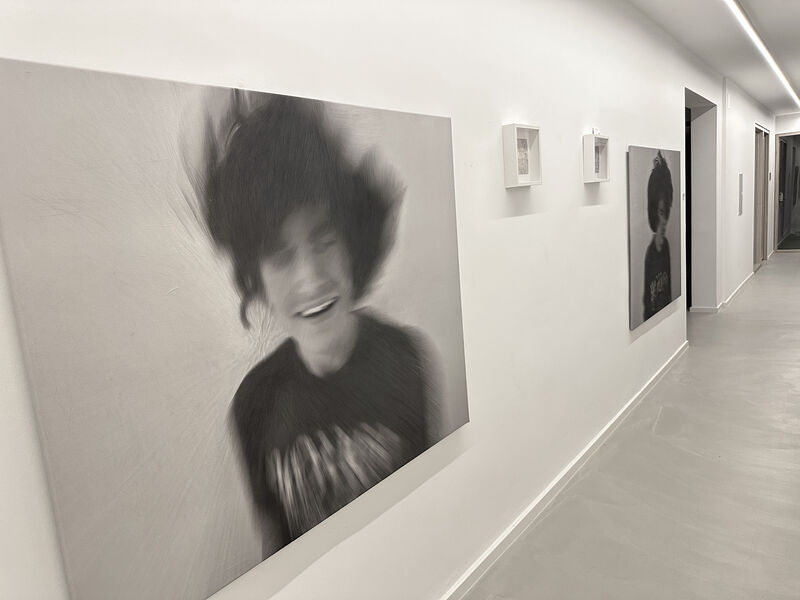
Some drawings are part of a »social sculpture« in a performative setting, as you describe. What exactly does that mean?
»Social sculpture« is a so-called expanded concept of art, coined by Joseph Beuys, who pursued a process-based art that has a formative effect on society. The decisive factor here is the inclusion of human action in a work. In 2019, I participated for the first time in a »social sculpture«, the tree planting along the former death strip between Kassel and Eisenach. It was initiated by Johannes Stüttgen (a student of Beuys) based on the example of a landscape artwork by Beuys »7000 oaks – urban reforestation instead of urban administration« (on the occasion of Documenta 7). I got to know Johannes Stüttgen in 2019 through Frank H. Wilhelmi. Stüttgen and Wilhelmi had already founded a design initiative for art and business 20 years ago. In 2019-2022, I had discussed the topic of »social sculpture« in depth with Frank H. Wilhelmi on the occasion of my plan at the time to found the Arteconomie design initiative for art and business in cooperation with the Frauenmuseum Bonn.
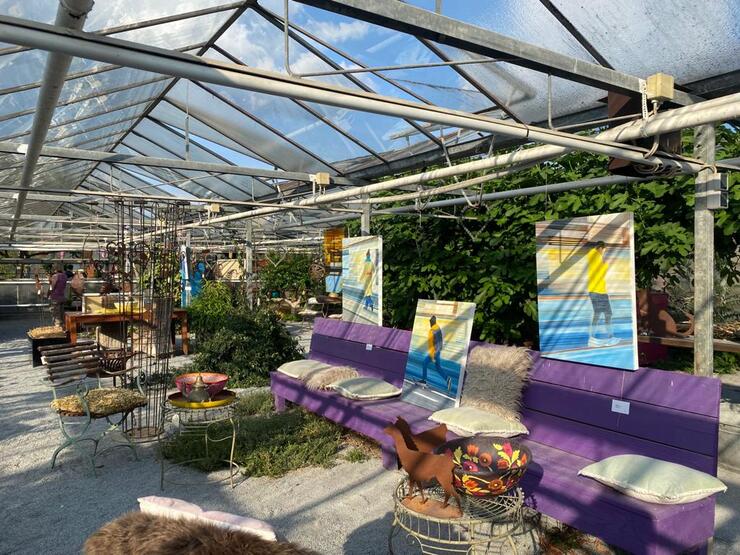
My first drawings were created after a spontaneous performative action with the contemporary painter and performance artist Robert Reschkowski as part of an exhibition at the Künstlerforum with the BBK Düsseldorf. I photographed his performative action during the vernissage and further processed it intermedially with felt and presented it in another exhibition on the occasion of the Kunstpunkte exhibition at the Künstlerforum. This was followed by further actions in which I photographed Reschkowski in the exhibition and then drew him. Later, I created »Robert on the move« and »Waiting for the Exhibition«. Now the idea was born to plan future joint environments in which visitors would be invited to interact.
Robert Reschkowski is curating the »Kunstgutforum« in collaboration with the »Lagergut« Krefeld group of companies, which will be showing contemporary, advanced artistic positions from September 2025. Under the exhibition title »On the move«, my works will be presented in mid-October 2025 in a solo exhibition in the main building of the CasinoStahlwerk industrial monument in Willich.
The blurring and the theme of proximity/distance, which are also central to her new felt works, can be found again in the graphite drawings. Please describe what is meant by this and how the concept has been expanded or changed by working with graphite.
The closer we get to a person physically or mentally, the more indistinct they become for us. They virtually disintegrate before our eyes into a thousand individual parts and facets that we can no longer see up close. It is only possible to see and perceive people as a whole from a healthy distance. This blurring is particularly well expressed in the felt works, while in the pencil drawings, especially in the more recent works, the theme of movement is given more weight. In the work »Restless legs«, for example, elements of the ready-made (tap/bathtub) are counteracted by the movement of the feet in the naturalistically depicted water. Blurriness is created here above all in the areas that move. In other words, in all living things that are capable and able to move.
The drawings are between 150 and 180 x 130 cm in size. How and why did you decide on this? Have you also experimented with larger and smaller formats?
At this point I would like to quote Walter Dahn: »The picture itself knows what it needs«. I am not bound to formats in terms of content. For me, the works are about the right relationship between the factors of time and space. Who do I serve by creating impressive works of scale, while museums are overcrowded with such huge works? For me, social sculpture also means that works are spatially manageable. In times when we are destroying our living spaces with »higher, faster, further«, I limit the dimensions of my works to a maximum of 180–200 cm. This width corresponds approximately to my own arm span.
Of course, there are also smaller works in my repertoire. For example, as part of our exhibition Fifty x Fifty with the Bonn artists' group, I created drawings on canvas measuring 50 x 50 cm for the cultural space in Bad Honnef town hall. This exhibition was about the theme of limitation. Do works of art that are limited in their freedom by a fixed size work? I wouldn't have chosen this format myself and initially found it very difficult, but in the overall context of the exhibition it was an interesting experience.
The graphite drawings are also interesting in comparison with your »synaesthetic portraits«. Could you explain the concept of these paintings and their relationship to the black and white drawings?
There are different phases and versions of the synaesthetic portraits. The core theme of these works is the reverse of abstraction. I do not abstract, but concretize and materialize a perception that I cannot describe and give it a form. The colors serve as translation modules.
Every color has an essence and every person has a kind of essence spectrum, which I can initially assign to the four elements fire, water, earth and air. I establish links between the essence of the color and human traits, assign or classify them, and give my perception a concrete form. What I have previously realized as abstract perception is now given space. The invisible is made visible.
And here is the interface to my drawings, in that I create space for little-noticed sequences of perception and elevate the obviously inconspicuous to a work of art.
While the drawings in the »on the move« series depict people as bust portraits or full-body portraits, in Restless legs and Waiting for the exhibition you conspicuously direct the gaze downwards, to the feet. What significance do you see in this, for example in terms of a »change of perspective«?
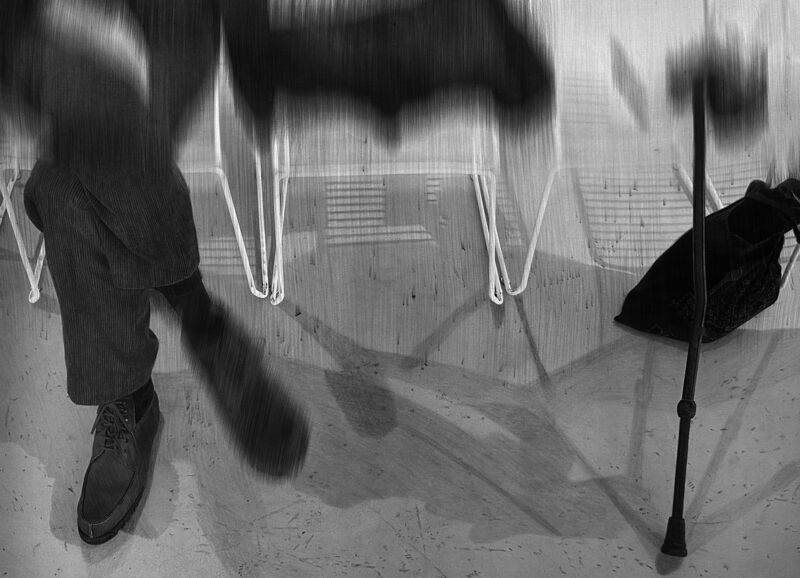
The portraits »Tim on the move«, »Robert on the move« etc. are just as much a part of the »On the move« series as the new works »Restless legs« and »Waiting for the exhibition«. All the works are about movement. Everything is always in motion. In the smallest as well as the largest. Microcosm, macrocosm. »Standing still is death« sings Herbert Grönemeyer in his song »Bleibt alles anders«. In the new works, the statement is expanded. As described above, they are about snapshots that usually go unnoticed. Sequences that you look at by chance without attaching any meaning to them. Legs placed in front of a chair. A randomly discarded bag on the floor and a walking stick. While the people here are largely blurred and incompletely depicted, the shadows are all the sharper. The actual subject becomes arbitrary, while the shadows, which are otherwise so incidental, gain in significance. A change of perspective occurs in these works through a shift in attention. I place a different emphasis and in doing so also break with habits.
Did Surrealism and Expressionism, which influenced her early work, play a role again in the graphite drawings?
Surrealism is characterized by dream images. Scenes that cannot exist. My new works initially reminded me of this early phase, in which I intensively explored various genres of classical modernism. Surrealism is very inventive and plays with the supernatural, the dreamlike and the impossible.
My works are about something much more real. I don't invent, but take up – I observe and reinterpret reality by re-centering focal points and uncovering connections where you wouldn't have suspected them before.
Thank you very much for the interview.
Bringing time to a standstill with photography: Berlin-based photographer Elitza Nanova not only captures the dynamics of dance, but also her fascination with fleeting moments for eternity. In an in-depth conversation, she provides deep insights into her practice. The interview was conducted by Mario Stumpfe.
The artist Marianne Hopf spent two months in Damnatz on the Elbe at the end of 2024 as part of a residency scholarship. The artist explores the dynamics of nature. In this interview, she gives us a closer look at her stay.
Art for the harmonious coexistence of the global population: At the Haus der Kunst in Munich, Argentine artist Tomás Saraceno presents visions for new forms of living together. The exhibition Tomás Saraceno. Ancestral Futures opens on July 17.
A unique body of work: Tate Modern is presenting the Cuban artist Ana Mendieta with over 150 works, including films, installations, and rarely seen paintings. The exhibition of the same name opens on July 15 in London.